
Parenting styles explained simply: a style isn’t a technique or a trick. It’s the feeling at home, the way your child feels around you every single day. In our house, my two boys respond very differently to the same rule, which is why I stopped expecting one approach to fit everyone.
I once followed a mom group’s debate on parenting styles, and it was — a lot. One mom said gentle parenting was the only respectful approach. Another said boundaries without consequences were just permissive parenting with a rebrand. A third said he was raised strictly and turned out fine. I sat there, reading every reply, and realized I had no idea where I actually stood.
So I did what any millennial parent does at 11pm — I took a parenting style quiz. Answered every question honestly. Hit submit. The result came back: permissive. I laughed. Then I read the description. Then I didn’t laugh anymore. Because some of it was uncomfortably accurate, and I needed to figure out what I actually believed before my boys figured it out for me.
Parenting Styles Explained: What They Actually Mean
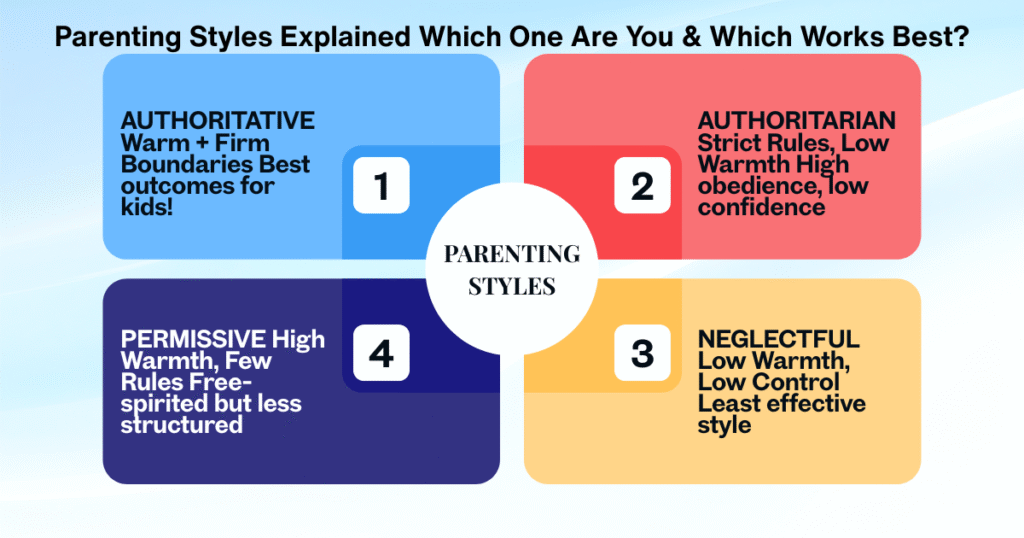
Parenting styles explained simply — they’re not techniques. They’re the overall emotional climate you create for your child. The four main styles come from psychologist Diana Baumrind’s research and have been studied for a long time. Authoritative, authoritarian, permissive, uninvolved — each one sits at a different point on two axes: how warm you are, and how demanding you are.
Most parents land somewhere in the middle of all four, leaning harder toward one depending on the day, the situation, and, honestly, how much sleep they got. Here’s what nobody told me: the styles overlap, because most parents are doing a mix, not a single style, and most don’t realize it until they actually look.
Authoritative vs Authoritarian — What I Noticed in Myself
These two sound almost identical.
They are not. Authoritative parenting — the one the APA consistently ranks highest for results— is warm and structured. High expectations with real support. Rules explained, not just enforced. Boundaries that come with reasons.
The APA describes it as supportive and responsive while still maintaining firm limits. Children raised this way tend to become independent, curious, cooperative, and better at handling stress. Authoritarian parenting is strict but emotionally distant.
“Because I said so” is the operating sentence. Obedience is the goal. Warmth is secondary. Children raised this way can become compliant — but also more likely to be impulsive or rebellious when the authority figure isn’t present.
I recognized both in myself on the same Tuesday. I explained why we don’t hit — authoritative. I lost patience, “I already told you no,” without explaining — authoritarian. Most parents do this. The question is which one you default to when you’re tired, late, or at your limit.
Honestly, this surprised me too. one clear style, I don’t. Nobody does.
Permissive and Gentle Parenting — When Things Got Confusing
This is where the mom group argument made sense to me.
Permissive parenting is warm but low on structure. Lots of love, few consistent boundaries. The APA says children raised this way can become impulsive, less self-reliant, and sometimes struggle with self-control. Not because they weren’t loved, but because they weren’t given enough friction to practice managing themselves.
Gentle parenting looks similar on the surface, but it isn’t the same thing. Gentle parenting has boundaries — they’re just communicated differently. Validation before correction. Explanations over punishments. Connection before direction.
The CDC’s positive parenting resources are built on the idea that warm, consistent guidance helps children grow. I’ve been there — thinking I was practicing gentle parenting when I was actually just keeping the peace because I was exhausted.
Let me be real with you: gentle parenting and burnout often live side by side. Those two numbers live together for a reason. Gentle parenting done well takes real energy. Done while depleted, it slides into permissive without you noticing.
Uninvolved Parenting — What Surprised Me Most
In every survey of parenting styles explained, nobody identifies as uninvolved. Very few parents say this is their style — and most of them probably don’t mean it the way the research defines it.
True uninvolved parenting is unresponsive, unavailable, and sometimes rejecting. The APA is clear — children raised this way show low self-esteem, little self-confidence, and significant emotional gaps. It’s the style with the worst outcomes across every measure.
But here’s what nobody talks about — uninvolved moments happen to every parent. The phone in hand during dinner. The “mm-hmm” when you’re not actually listening. The evening where you’re physically present but mentally completely gone. Those moments don’t make you uninvolved. Patterns do.
This one thing changed everything for me — I stopped judging my parenting by the moments and started looking at the patterns. One snapped response doesn’t make me authoritarian. One boundary I didn’t hold doesn’t make me permissive. What matters is what I do most of the time, and whether I repair the moments I get wrong. Whatever style you’re working with, staying focused and responsive is non-negotiable.
What studies actually support
Among all the parenting styles explained here, authoritative parenting has the most convincing research findings. Academic outcomes, social-emotional development, behavioral regulation, and emotional strength under stress — authoritative parenting regularly ranks highest across all of them.
What makes it work isn’t the strictness or the warmth alone — it’s both together. High expectations paired with genuine support. Rules with reasons. Consequences with empathy.
Here’s what nobody told me — you don’t have to pick one style and commit to it forever. Self-doubt isn’t failure. It’s the sign of someone paying attention.
The goal isn’t a perfect style. It’s a consistent enough approach that your child knows what to expect from you — and knows that you’re on their side even when you’re setting a limit.
What Actually Helped Me Figure This Out
After reading so many parenting styles explained online, I stopped trying to label myself and started asking a simpler question.
After a difficult moment with one of my boys — a boundary I set, a consequence I gave, a conversation we had — I’d ask: did he feel heard? Did he understand why? Did he feel like I was with him or against him?
Not every answer was yes. But asking the question regularly shifted how I handled the next moment.
I also stopped trying to parent other people. The mom group, the comments section, the relative with opinions — none of them are in my house at 7pm when my son is overtired, and I’m making dinner and something tips over. My parenting happens in those moments. Not in the philosophy I post about.
Be loving. Be consistent. Explain your reasoning. Repair when you get it wrong. That mix, no matter what it’s named, produces children who feel safe and know they’re loved.
Parenting styles explained come down to one thing — warmth and structure, in different combinations.
FAQ
1. What is the most effective parenting style?
Authoritative — found again and again across decades of studies. It combines caring with structure, high requirements with actual support. Children brought up this way show better academic, social, and emotional results than any other group.
2. Is gentle parenting the same as permissive parenting?
No — and this confusion is a common source of disagreements. Gentle parenting has boundaries and expectations. Permissive parenting avoids them. The difference is structure, not warmth. Both styles can be warm. Only one has consistent limits.
3. Can I have more than one parenting style?
Yes — and most parents do. Parenting styles explained in books look neat, but real life is a mix. Consistent patterns across months and years are what actually shape your child’s development.
4. Is authoritarian parenting always harmful?
Research shows it produces more negative outcomes on average — but context matters. Cultural background, the child’s temperament, and the loving relationship all affect how a child experiences firm parenting. Highly structured rules without warmth are the problem, not the act of being firm.
5. How do I know which parenting style I actually use?
Watch how you handle things when your energy and patience are low. That’s your default. Most parents are at their best in calm moments — the revealing moments are the hard ones. Observe what you do, then decide if it matches the approach you want to take.
I still don’t have a clean label for how I parent my boys. Some days I’m very authoritative. Some days I’m more permissive than I mean to be.
Some days I’m just trying to get everyone through dinner without losing control emotionally — theirs or mine. One thing I’m certain of is that they feel secure, recognize the limits, and know I’m in their corner. That’s what I keep coming back to mentally. That’s what I keep focusing on.
With love from BabyGuideNest 💛