
Parenting mistakes to avoid are rarely dramatic — they are quiet, repeated habits that add up faster than any big decision ever does. I was getting one thing done after another that afternoon. “You did a wonderful job!” “That’s awesome!” “You came up with a great solution!” Every single thing Ayla did got a full celebration. Then she stopped, looked at me, and asked — “Mama, was that actually good, or are you just saying that?”
I genuinely didn’t have an answer ready. She was three. And she had just called out one of the most common parenting mistakes to avoid without even knowing it had a name.
A few weeks later, I did something worse. We were at her cousin’s birthday party, and I said, completely without thinking, “Look how nicely she’s sharing — why don’t you do that?” Ayla’s face changed immediately. She was silent from then on. She just got quiet and moved away to play alone. I stood there replaying the sentence in my head and realized exactly what I’d done.
Nobody warns you that the small things — the praise, the comparisons, the quick rescues — add up faster than the big parenting decisions ever do.

What Parenting Mistakes Actually Mean
Here’s the thing — nobody sets out to make these mistakes. They quietly move in through habit, tiredness, and good intentions gone. Turned slightly to the side.
A typical parent may make around 221 minor parenting errors every year. Over the course of childhood, that’s nearly 3,978 opportunities to influence how a child thinks about themselves.
Most of these aren’t dramatic. They’re quiet, repeated patterns — the kind that feel harmless in the moment and only show their effect years later.
Parenthood doesn’t come with complete preparation for most people. We’re learning as we go, which means mistakes are often signs of growth, not signs of failure. They’re just part of the process — as long as we catch the patterns before they become permanent habits.
Over-Praising — What I Noticed With Ayla
That “wow, great job” moment stuck with me longer than I expected. Developmental psychologists recommend a 5-to-1 praise-to-correction ratio — five positive comments for every correction. That sounds generous. But there’s a difference between meaningful praise and constant effusive praise for everything, regardless of effort. Here’s what nobody told me — children praised excessively and indiscriminately often develop a fixed mindset. They start avoiding challenges because struggling would mean losing that appreciation. Research links too much praise to lower self-esteem, increased anxiety, and a habit to avoid anything that isn’t Sure to succeed. Honestly, this surprised me too. I thought constant praise was pure encouragement. It can actually create pressure — the child starts performing for the praise instead of engaging with the activity itself.
I started being more specific. Alternatively, “great job,” I’d say, “you kept trying even when the puzzle piece didn’t fit right away.” That’s praise, dependent on effort, not result. It felt smaller at the moment. It mattered more over time.

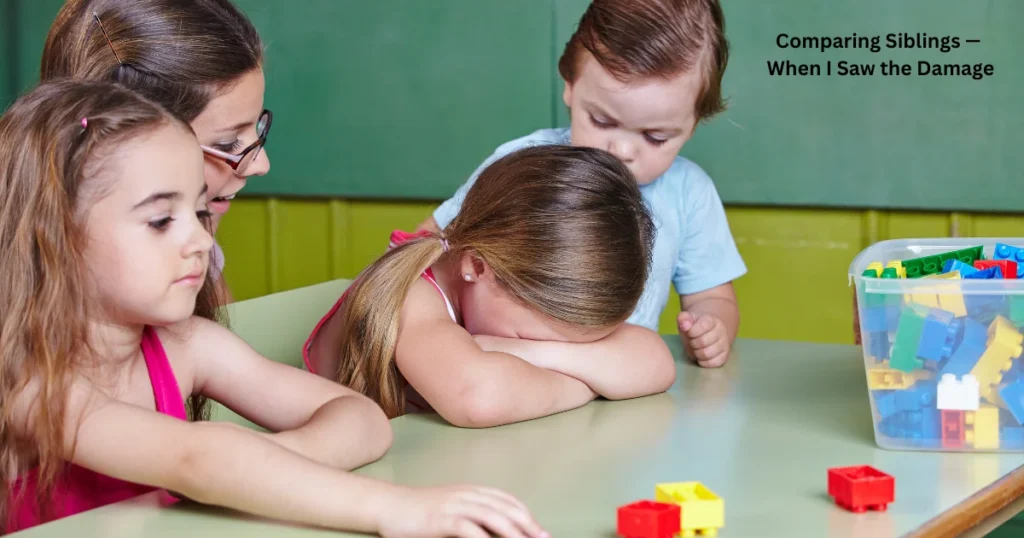
Comparing Siblings — When I Saw the Damage
The birthday party comment haunted me for days. Comparing children — siblings, cousins, classmates — feels harmless when it’s meant to motivate. It rarely works that way. Research has found that sibling comparison can create measurable academic gaps — around a 0.21 GPA difference that’s small in any single moment but accumulates significantly over the years.
Let me be real with you — what makes this worse is that a parent’s belief about which child is “smarter” affects that child’s future grades independently of their actual past performance. The comparison becomes a self-fulfilling pattern, not just a passing comment.
The Dove Self-Esteem Project has linked comparison-based parenting to low self-esteem, body dissatisfaction, and even disordered eating patterns later on. That’s a heavier consequence than most parents realize is sitting inside an offhand sentence at a birthday party.
I’ve been there — it’s exhausting watching yourself in real time and realizing a comment you didn’t think twice about landed somewhere deep. I apologized to Ayla that same day, even though she’s three and may not have understood every word. The repair mattered more than the explanation.
Rescuing Too Fast & Inconsistent Rules — What Surprised Me Most
I used to catch Ayla’s block tower before it fell. Every single time. I think I was being a responsible parent.
I wasn’t giving her the opportunity to experience the fall and learn what to do next. Rescuing children from minor struggles — a falling tower, a tricky puzzle, a small social conflict — removes the exact moments they need to build problem-solving skills. Experts are clear that this pattern, repeated often enough, leaves children less equipped to handle setbacks later.
This one thing changed everything — I started waiting. Just a few seconds longer before stepping in. Watching her try first. It felt uncomfortable initially. It worked.
Inconsistent rules surprised me, too. One day, a rule was firm. The next day, I was too tired to enforce it and let it slide. Research shows inconsistent discipline creates real frustration and anxiety in children — they genuinely don’t know what to expect, which makes them feel less secure, not freer. 54% of dads admit to being overprotective, while 35% say they give in too quickly to demands. Both patterns — too rigid and too lenient — cause confusion when they’re inconsistent.
When to Take some time to Reflect
Most parenting mistakes are manageable the moment you pay attention to them. But some patterns deserve closer attention.
If overcontrolling behavior is constant rather than occasional — that’s worth examining. Research has found that children with highly rigid parents at age two show reduced emotional and behavioral regulation by age five. If you notice yourself progressing in every small struggle, every single day, that pattern is worth disturbing sooner rather than later.
If criticism is outweighing praise — 49% of dads admit to criticizing too often — that ratio matters. Children develop their internal voice from what they consistently hear from you. If your child seems anxious about trying new things, avoids challenges, or seeks excessive reassurance before attempting anything, these are signs worth discussing with a pediatrician or child psychologist, not just self-correcting alone.
What Actually Helped Us
I started noticing my own patterns before reacting to Ayla’s.
Was I praising the effort or just the outcome? Was I about to analyse her to someone else? Was I helping her understand something she could actually understand herself? Those three questions, asked quickly in the moment, changed more than any parenting book did.
I also stopped aiming for a perfect average. The 5-to-1 praise-to-correction ratio isn’t a daily quota you track with a notebook — it’s a general direction. Some days I lean too critical. Some days I lean too soft. What matters is correcting courses over weeks, not perfecting every single day.
And I let her fall sometimes. The block tower, the puzzle piece, the small disagreement with a cousin. Not every struggle needs my hand in it. That was the hardest mistake to unlearn — and the one that mattered most.
FAQ
Q1: Am I overpraising her in a way that could be harmful?
Depends what you’re praising. I used to say “you’re so smart” for everything — every drawing, every block tower. Research shows that this type of praise can work against you, causing kids to worry about failing. “You kept trying even when it got hard” does more than “amazing job” ever will.
2. How do I stop comparing my kids without realizing it?
Catch the sentence before it leaves your mouth — that’s the real skill. Instead of comparing yourself to a sibling or cousin, describe the specific behavior you want to encourage directly: “I love how you tried that on your own” works better than any comparison ever will.
Q3: Is it bad that I jump in to help so quickly?
Once in a while, no. But if you’re always the one solving it before she even tries — that’s where it becomes a problem. She needs to sit with the struggle for a bit. That’s actually how problem-solving gets built.
Q4: What’s this praise-to-correction ratio everyone mentions?
Roughly five compliments for every one correction, according to psychologists. I don’t count it out loud or anything. It’s more of a gut check — am I criticizing way more than I’m encouraging lately? If yes, that’s the signal to Reorganize.
Q5: Is this something ongoing, or just an off week?
Watch her, not the calendar. If she’s suddenly nervous to try new things, or keeps asking “was that good?” after everything, or gets quiet after being compared to someone — that’s not a one-off. That’s worth bringing up with her pediatrician, not just brushing off.
—
I’m not getting this perfect. Nobody does. Some days I praise too much, compare without meaning to, or step in before I should. What’s changed is that I notice it now — and noticing is most of the work.
With love from BabyGuideNest.