
I dropped my son at school one morning and sat in the car outside for ten minutes before driving away.
The night before had been rough. I’d raised my voice over something small. He’d cried. I’d felt terrible the rest of the evening and most of the night. Sitting in that car park, I kept replaying the moment on a loop: the way his face looked, the way I’d sounded, all of it. I was doing that thing where you become your own worst critic and stay there for hours.
Then three nights later everything layered at once. My son hadn’t slept properly in days, which meant I hadn’t either. By morning I was sitting at the kitchen table thinking, “I really cannot do this today.
Then he walked in with his hair going in four directions, climbed into my lap without asking, and just sat there. That was it. That simple moment completely reset something in me. But it also made me realize I had been running on empty for a long time, and I hadn’t done anything to refill.
That’s when positive parenting affirmations stopped being something I rolled my eyes at and became something I actually needed.
What Positive Parenting Affirmations Actually Mean
Not motivational posters. Not pastel quotes on Instagram that make you feel worse about yourself for not feeling inspired by them.
Affirmations for parenting are just short, honest phrases you say to yourself — out loud, regularly, when the internal critic gets too loud. That’s it. The research around them has been building, and what comes up consistently is one word: genuine.
A phrase you don’t believe at all does nothing. One that’s honest about the difficulty but gentle about how you’re handling it — that one actually lands over time.
Here’s the number that stopped me when I read it — 3.7 million parents said parenting was difficult in 2026. Nearly 2 million mothers said it hurt their mental health. 860,000 parents felt lonely every single day. Every single day. That’s not a limited number of people struggling. That’s most of us, quietly holding it together on the outside while running on fumes on the inside.
The Mom Guilt Stage — What I Noticed in Myself
Mom guilt doesn’t announce itself dramatically. It’s just always there.
A small sharp feeling every time I raised my voice. A heaviness after a day where I was distracted and not fully present. A comparison that ran constantly in the background — am I doing enough, am I patient enough, why does everyone else look like they have this figured out? My mind won’t stop replaying it, and it’s exhausting in a way that sleep doesn’t actually fix, because the thoughts are still there when you wake up.

What surprised me was realizing how universal the experience I’d been treating as a personal failure really is. What surprised me was seeing it written out and realizing how universal the experience I’d been treating as a personal failure was.
I started writing down the things I was saying to myself throughout a typical day. Not the things I said out loud. The internal ones. It was not a kind list. I wouldn’t have said anything to a friend that way. I was speaking to myself that way every single day.
When Affirmations Started Shifting Things
I didn’t start with a list of twenty. I started with a single positive parenting affirmation: “I don’t have to be perfect to be a good mother.” I put it on a sticky note on the bathroom mirror, yes, exactly like that, and said it out loud every morning for two weeks. My husband saw it and said nothing, which was the correct choice.
You may have heard that a new habit takes 21 days. That’s a myth. A well-known study found it took people anywhere from 18 to 254 days, with an average of about 66, so don’t worry if it feels slow. I didn’t track days. I just noticed that somewhere in week two I stopped automatically assuming the worst about myself after a hard moment.

Honestly, this surprised me too. I had expected the phrases to feel hollow. They did at first. Then they started landing differently — not as something I was forcing myself to believe, but as a genuine interruption to a thought pattern I hadn’t realized was running constantly.
The emotional engagement piece matters here. Saying a phrase while half-distracted does less than saying it and actually sitting with it for a second. That difference — presence versus habit — is what separates an affirmation that works from one that just hangs on a wall.
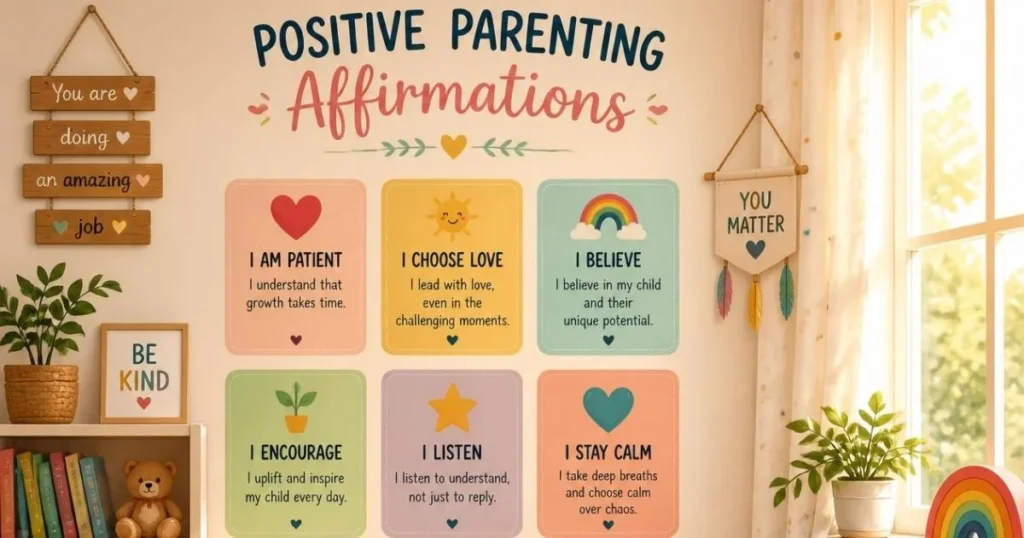
The 20 Positive Parenting Affirmations That Actually Helped
These came from rock bottom moments, not research. The night my son wouldn’t sleep, I lost my patience completely. In the morning, I dropped him off and cried in the car. Tuesday afternoon I actually thought I wasn’t cut out for this. Those moments built this list. Say whichever one fits today. Some mornings it’s one. Some mornings it’s all twenty before 8 am.
When you can’t stop feeling guilty:
- I am permitted to make mistakes and yet be a good mother.
- One challenging situation does not define my whole day.
- My child needs a real mother, not a perfect one.
- I apologized. That matters. That’s what good parents do.
- Guilt means I care. Caring means I’m already trying.
When I’m running on empty:
6. I am doing this tired, and that counts.
7. Messy is still there. Still counts.
8. Rest is part of the job too.
9. Just today. Just get through today.
10. Hard day or not — he still reaches for me. That means something.
When I need to be more gentle to myself:
11. I wouldn’t say this to any other mother. So I’m not saying it to myself either.
12. He’s new at this. I’m new at this. Neither of us has done it before.
13. My value as a mother is not measured by his behavior today.
14. I am more than my bad parenting moment.
15. I give myself the grace I give everyone else.
When I need to just reset:
16. Yesterday happened. Today is a new day.
17. Showing up every day is better than doing it perfectly once.
18. I got some things wrong today. I also got some things right. Both are true.
19. I am present. That is enough.
20. He knows. He already knows.
What Surprised Me Most
Positive parenting affirmations only work when they feel genuine.
Not flattery. Not exaggerating. Not telling yourself something you completely don’t believe just to feel better for thirty seconds. Phrases that acknowledge difficulty while reframing your internal narrative are the ones that worked for me.
I tried repeating something positive and felt ridiculous the whole time, because it was too far from where I actually was. The fix isn’t more positivity. It’s more honesty paired with gentleness. That combination is harder than it sounds and more effective than the posters suggest. Let me be real with you — 15% of parents gave up work to care for children in 2026.
If you’re struggling, really struggling, a list of phrases isn’t going to fix that. Get real help. Rest when you can. Ask someone. Affirmations are just for the noise in your head on a regular Tuesday, not for when things have become too heavy to carry alone.
When Positive Parenting Affirmations Aren’t Enough
Affirmations help with the daily internal noise. They aren’t meant to treat clinical anxiety, postpartum depression, or burnout that requires professional support.
If guilt has turned into feeling worthless. If exhaustion has gone quiet and flat instead of just tired. If you’re pulling away from him instead of losing patience with him, those are different things. Those need an actual person, not a line on a mirror.
Organizations like UNICEF run parenting programs because this is hard and parents need real support. Go get it. No explanation needed.
Positive Parenting Affirmations: What Actually Helped Us
These positive parenting affirmations didn’t come from research. They came from rock bottom moments that needed somewhere honest to land.
The bathroom mirror note. Genuinely. One phrase. Morning. Out loud. That was the starting point. I built from there over weeks, not overnight. I added a second phrase when the first one felt solid, and chose phrases that matched what I was actually struggling with rather than a generic list written for a different life. Ten minutes of one-on-one time with my son every day, with no phone and no task running in the background, also did something the affirmations alone couldn’t.
Connection resets guilt faster than anything I’ve found. Even ten minutes of true connection, done consistently, changes the quality of everything around it. And I stopped measuring my parenting by his behavior on a given day. Separating my worth as a mother from whether he had a meltdown at the supermarket was the most important shift of all.
Positive Parenting Affirmations FAQs
1. Do positive parenting affirmations actually work?
When they’re genuine and consistent, they can help. They won’t fix everything, but they can interrupt a harsh inner voice. False flattery doesn’t work. Honest reframing does.
2. How long until I notice a difference?
Somewhere around two to three weeks for most people — but honestly I stopped counting days. One morning it just felt different. Can’t explain it better than that. Say it out loud — don’t just read it in your head. That’s the actual difference.
3. What’s the difference between affirmations and toxic positivity?
One sits with you in the mess. The other pretends there’s no mess. Toxic positivity pretends the hard thing isn’t there. “I’m trying and that counts” — affirmation. “Everything is fine” when you’re falling apart — not the same thing at all.
4. I feel ridiculous saying these out loud — is that normal?
Yes. I said mine to the bathroom mirror for a week feeling completely ridiculous. Keep going anyway. Somewhere around day ten something shifted for me. Try it for ten days before deciding it’s not working.
5. Should affirmations replace professional support?
No. They’re a daily mental tool, not a treatment. If you’re experiencing persistent low mood, numbness, anxiety, or withdrawal — please talk to a healthcare professional. Affirmations and real support work best together, not as substitutes for each other.
That morning in the car park, and the kitchen table morning after the sleepless nights — both of those moments were real. They were hard. They didn’t make me a bad mother.
They made me a tired one who needed something to hold onto.
These twenty positive parenting affirmations are what I hold onto now. I hope some of them hold something for you too.
With love from BabyGuideNest 💛
A Quick Note:
I’m Hafiza Sumaira, a mom of two, not a doctor or a therapist. This post comes from my own hard days and what I learned from them, and it is not medical or mental health advice. If what you’re carrying feels bigger than a few phrases can touch, please talk to a doctor, a counselor, or someone you trust. You deserve real support.