
A baby nap schedule shifts more often than most parents expect — and getting the timing wrong can undo weeks of good sleep in just a few days.
My son just stopped napping one Tuesday. No warning. No gradual fade. Just — done.

The nap schedule had been one of the few things working in our routine, and he dismantled it in a single afternoon as if it had never mattered. I waited three days thinking it was a phase. Then a week. Then I made the mistake of deciding he was clearly ready to drop the nap entirely and just move on.
Bedtime that week was a disaster. Full crying by 5 pm. Falling asleep at dinner. Waking at 4:30 am completely unable to resettle. I had dropped the nap too early, pushed through on the same bedtime, and created an overtired, miserable toddler who was now sleeping worse than he had been before any of this started. I had to go backwards. Add the nap back. Start again. It took two weeks to undo four days of bad decisions.

What Nap Schedules and Nap Drops Actually Mean
Nap transitions are developmental — they happen on a baby’s timeline, not a parent’s preference or a friend’s baby’s schedule.
A baby nap schedule shifts multiple times across the first few years. Most babies go from 4 to 5 naps at birth down to 3 naps around 4 to 6 months. Then 2 naps from around 6 to 10 months. Then 1 nap somewhere between 12 and 18 months — most commonly 13 to 18 months. And finally, no naps, usually between 3 and 5 years, though many children are done by around 3 or 4.
Here’s what nobody told me — dropping a nap too early doesn’t just mean a missed nap. It creates a chain reaction. Overtiredness. Harder bedtimes. Earlier mornings. More night waking. The system falls apart in multiple directions at once when you move before the baby is actually ready.
The First Drop — What I Noticed at 8 Months
Around 8 months, he started fighting his third nap — the late afternoon catnap — every single day.
Not occasionally refusing. Every day. Fussing, refusing to settle, at times going down asleep for 15 minutes and waking up more cranky than before. That third nap is typically the first to go, and it it often disappears somewhere between 6 and 9 months.
One refused nap is not a transition signal. Two weeks of consistent refusal is. One bad nap day can be teething, overstimulation, a schedule shift, anything. The rule most sleep specialists suggest is to wait for at least two weeks of consistent signs before calling it a real transition.
I made a decision based on four days of data and paid for it with two weeks of chaos.
The Second Drop — When Everything Shifted at 14 Months
The 2-nap to 1-nap transition was harder because the signs were so mixed.
Some days my son was clearly ready — taking forever to fall asleep for the morning nap, short napping, fighting the afternoon one. Other days he crashed for both naps and woke up perfectly happy. The inconsistency made it genuinely difficult to read.
Most babies make this move between 13 and 18 months. The morning nap is the one that disappears during this transition — and when it goes, the single remaining nap typically shifts to midday or just after.
I kept bedtime at the same time during this transition, and that was the mistake. When daytime sleep reduces, the body needs nighttime sleep to come earlier to compensate. Moving bedtime earlier — even by 30 to 45 minutes — during a nap transition reduces overtiredness dramatically. Most parents skip this completely and then wonder why bedtime suddenly became a battle.
Earlier bedtime during the transition week fixed what felt like an unsolvable bedtime problem in about three days.
A Simple Week-by-Week Plan for Moving From Two Naps to One
If your little one is around 13 to 18 months and fighting the morning nap, don’t rush. This is one way to ease into a single nap. Not the only way.
Week 1: Push the morning nap a little later, about 15 minutes every 3 or 4 days, and leave the afternoon nap alone because it shrinks on its own. If it’s a short nap day, put them to bed 30 to 60 minutes earlier.
Week 2: The morning nap has usually crept to around 11:30 or noon by now. That’s your one nap. Some days it’s 2 hours, some days it’s 45 minutes and a cranky kid. Both happen.
Weeks 3 and 4: Try to keep the same schedule even after a bad day. If the late afternoon falls apart, a 20-minute rest is okay, but any longer and bedtime starts slipping.
Dropping the Last Nap — What Surprised Me Most
The final nap drop — from one nap to none — is the one nobody tells you about properly.
It normally happens between 3 and 4 years, though the range continues to 5. He started resisting his afternoon nap regularly around 3 years and 2 months. I recognized the pattern this time. Waited two weeks of consistent signs before doing anything. Then adjusted.
How do you know it’s a real transition and not just a rough patch? Look for three things together: your toddler refuses the nap for 10 to 14 days in a row, still sleeps 10 to 12 hours at night on the days without a nap, and bedtime goes smoothly on those same days. If only one or two of these are true, it’s more likely a regression, so it’s worth waiting a little longer.
What surprised me — most parents drop the nap too early because the child skips it a few times and the parent is done fighting it. But many children still need rest even when they’ve stopped sleeping. The solution isn’t just removing the nap. It’s replacing it with quiet time in the same slot.
Quiet time — 30 to 45 minutes in a calm space with books or soft toys — preserves the rest window even when sleep doesn’t happen anymore. His behavior in the evenings was measurably better on quiet time days than on days we skipped it entirely.
Some toddlers also need a short “bridge” catnap for a few weeks, especially on rough days. About 20 minutes around 3 or 4 pm is enough to stop the late afternoon meltdown, and it won’t ruin bedtime as long as it stays short and early.
When to Contact Your Child’s Doctor
Most nap transitions are developmental and need no medical input. A few situations are worth mentioning.
If your baby is showing extreme overtiredness, night waking that’s significantly worse than usual, or behavioral changes that don’t resolve after two to three weeks of transition adjustment — mention it at the next checkup. Sometimes what looks like a nap transition is actually a sleep regression, illness, or developmental leap that needs a different response.
If your child stops napping completely before age 3 and is showing signs of chronic overtiredness — crankiness, difficulty managing emotions, falling asleep in the car at unusual times — that’s worth a conversation with your pediatrician about whether total sleep needs are being met.
What Actually Helped Us
Every baby nap schedule change we made came down to the same rule: wait two weeks, then adjust bedtime, not the other way around.
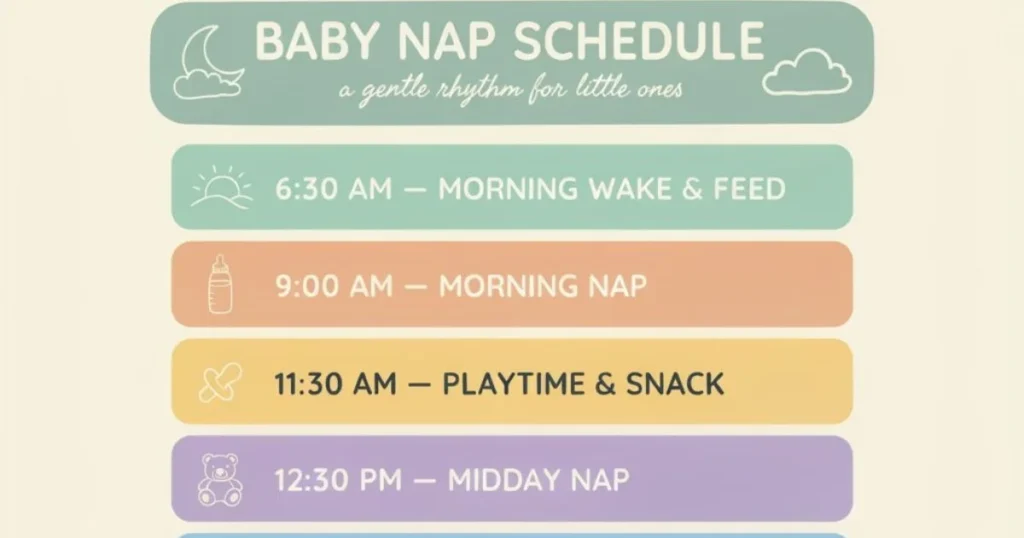
Three things, every transition.
Waiting for two consistent weeks of signs before acting. Not two days. Not one week. Two full weeks of the same pattern before making any schedule change. This single rule saved me from two more mistakes like the first one.
Moving bedtime earlier during the transition. Every time we dropped a nap, bedtime moved 30 to 45 minutes earlier for the first week. The body needs to compensate somewhere. Earlier bedtime during transition is one of the most effective and most skipped adjustments parents can make.
Not capping the remaining nap immediately. When he dropped from two naps to one I let the remaining nap lengthen naturally for the first week rather than limiting it. That longer nap helped his body adjust to the reduced total daytime sleep without hitting overtired territory while the transition settled.
And quiet time. Every day, in the same slot the nap used to be. Even when nothing happened. Especially when nothing happened.
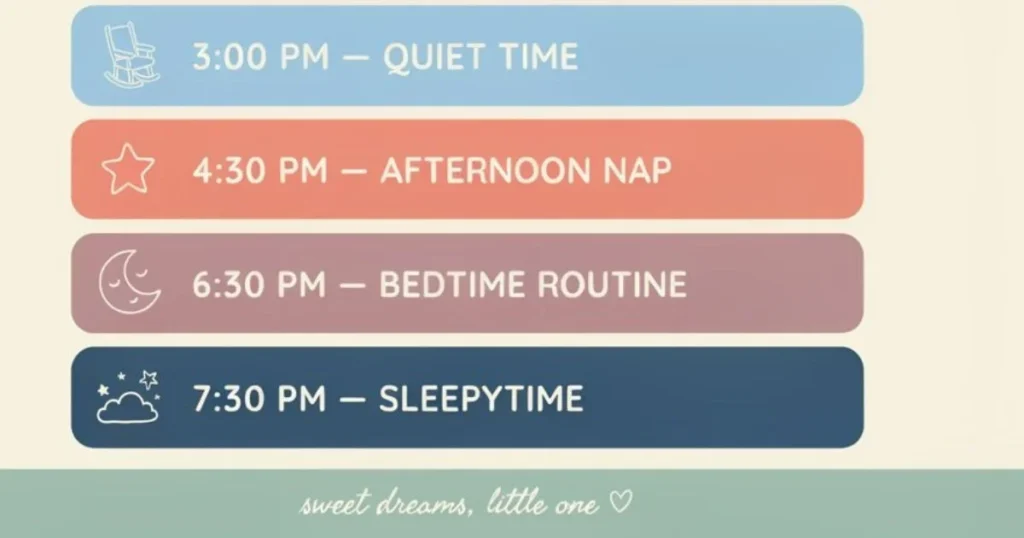
Naps follow the same safe sleep rules as night sleep.
FAQ
1. How do I know when my baby no longer needs a nap?
Look for at least two weeks of consistent signs — regularly fighting or refusing the nap, taking longer than 30 minutes to fall asleep for it, or napping briefly and waking cranky rather than rested. One or two bad nap days isn’t a transition. Two weeks of the same pattern usually is.
2. What happens if I change my baby nap schedule too early?
Overtiredness sets in fast — harder bedtimes, earlier morning waking, more night waking, more meltdowns. The system falls apart in multiple directions at once. If this happens, adding the nap back and resetting is faster than trying to push through.
3. Should I move to bedtime when taking a nap?
Yes — earlier, not later. Should I move bedtime earlier when dropping a nap? The body loses daytime sleep, so it needs nighttime sleep to kick in earlier. Even 30 to 45 minutes makes an actual difference that first week. I kept the same bedtime and paid for it. Don’t do that again.
4. At what age do most children stop napping?
Many kids stop napping between 3 and 5. Around 3 is most common, but honestly every child is different, and the range is genuinely wide. If the last nap is dropping before age 3 — just watch closely. Doesn’t mean something’s wrong. Just worth paying attention to.
5. What do I do when my child stops napping but needs rest?
Same time slot, same space, just without the sleep pressure. Books, soft toys, an audio story. Call it quiet time instead of nap time. Most kids tolerate it much better when the expectation shifts. And evenings are genuinely calmer on quiet time days — I noticed that within the first week.
That Tuesday when he just stopped napping, I had no idea what was coming. The mistake I made taught me more about nap transitions than any article I’d read before it.
Watch for two weeks. Move bedtime earlier. Don’t rush it. And if you get it wrong the first time — you can always go back.
With love from BabyGuideNest 💛
A Quick Note
I’m Hafiza Sumaira, a mom of two, not a sleep specialist. Everything in this post comes from my own experience and research I’ve read along the way. If nap transitions are causing significant sleep disruption that isn’t resolving — your pediatrician or a certified pediatric sleep consultant is the right next step, not more Googling at midnight.