
Four days. Ayla hadn’t gone in four days, and I was watching her like she was a ticking clock.
Baby constipation wasn’t something I’d thought much about before that week. I’d been tracking feeds and sleep since day one, but somehow bowel movements had fallen off my radar until, suddenly, they hadn’t happened for four days and I was Googling things at midnight that I won’t repeat here. Every source said something different. One said give juice. Another said absolutely no juice. One said warm bath. One said bicycle legs. One said to call the doctor immediately, and another said it was completely normal; wait it out.
I ended up in three different WhatsApp groups asking for advice simultaneously. Got five contradictory answers within ten minutes. My mother-in-law called to suggest something involving warm oil that I chose not to pursue. By the end of that evening, I had more information than when I started, but understood less.
What Baby Constipation Actually Means
Here’s the thing that nobody explained clearly at the start — constipation isn’t about how often. The main concern is the difficulty and pain when passing stool.
A baby has constipation when passing stool is difficult because the stool is hard and dry. An entirely breastfed baby can go various days without a bowel movement and be completely fine. A baby straining, crying, with hard pellet-like stools — that’s constipation regardless of how recent the last one was. That distinction matters enormously, and most parents — myself very much included — don’t know it until they’re four days deep into a Google spiral.
As many as 30%; the actual number may be lower if children experience constipation at some time in their lives. Up to 20% of toddlers are constipated at any particular moment. And 96% of cases are functional — meaning no underlying disease, just a digestive system that needs some help moving things along.

The Early Signs — What I Noticed With Ayla
When we introduced solids around six months ago, things changed fast.
Ayla went from regular, soft stools to suddenly going less often and straining noticeably when she did. Her belly looked slightly bloated some days. She was fussier than usual without an obvious reason. I kept second-guessing whether what I was seeing was actually a problem or just a normal adjustment to new foods.
Here’s what nobody told me — introducing solids is one of the most common triggers for constipation in babies. The gut is adjusting to processing real food for the first time, fiber intake shifts dramatically, and if fluids don’t increase alongside solids, things slow down fast. I was adding food without adding water, which was making everything worse without me realizing it.
Honestly, this surprised me too. I assumed more food would mean more output. The opposite happened until we figured out the fluid piece.
Toddler Stage — When It Came Back Around
Constipation became an issue again when Ayla was around two, and this time the trigger was dairy.
I hadn’t connected the two until her pediatrician mentioned that seems unwell can contribute to constipation in some children — not in all, but enough that a short, time-limited trial of reducing milk intake is sometimes worth trying. I cut back on her daily milk for two weeks, and the difference was noticeable within days.
I’ve been there — adding more fiber-rich foods thinking that was the whole answer, and watching things stay stuck anyway. Fiber without enough water actually makes constipation worse. Both have to move together. Most parents get the fiber tip but miss the fluid piece entirely, and that’s exactly why the problem keeps coming back despite their best efforts.

Let me be real with you — irregular routines make this worse too. Travel, diet changes, a disrupted schedule — all of it affects how regularly a toddler’s gut moves. Regularity in routine matters as much as what they’re really eating.
The thing that amazed me most
The juice question genuinely confused me for months because the advice was so contradictory everywhere I looked.
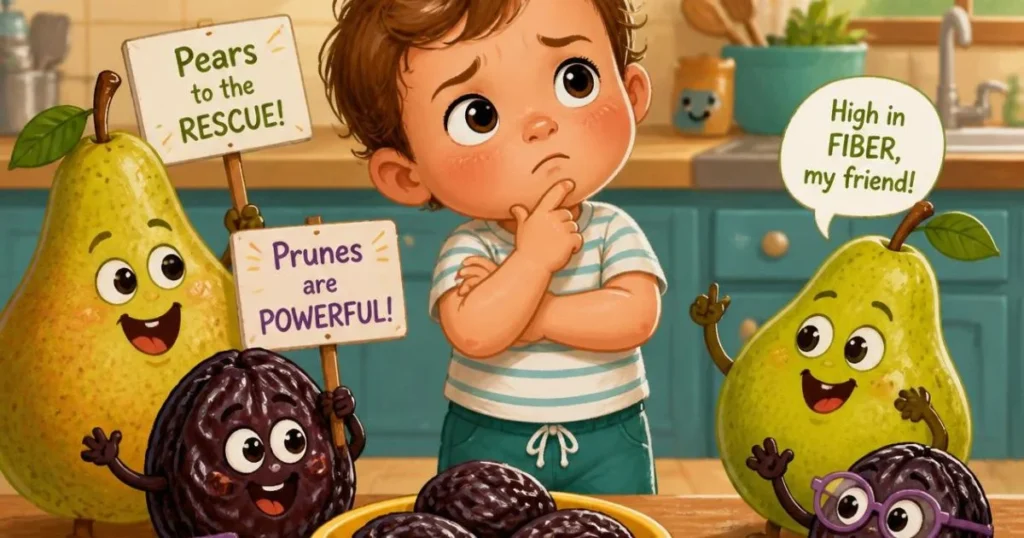
Here’s the actual answer — the AAP recommends talking to a pediatrician before giving infants small amounts of apple, pear, or prune juice to loosen stool. Not a blanket yes, not a blanket no. Age-appropriate amounts, specific juices, and ideally with pediatric input first. Prune juice in particular has a natural laxative effect, but the amount matters and it isn’t appropriate for very young infants without guidance.
This one thing changed everything — I stopped looking for one magic fix and started treating it as a combination of things that all needed to work together. More water. Age-appropriate fiber. A consistent toilet routine after meals. Less cow’s milk. And patience with the process instead of jumping to whatever someone recommended on a forum at 11 pm.
The biofeedback thing also surprised me — some parents try it for persistent constipation, and research shows it actually doesn’t improve outcomes for functional constipation. Simple behavioral education and consistent toilet routines do more than any specialized technique.
When to Actually Call the Doctor
Most baby constipation conditions respond to home treatment within a few days. Some situations need medical attention and should not be waited out.
Call your child’s specialist if your baby has not had a bowel movement in more than 5 to 6 days, if there’s blood in the stool, if your baby cries or seems to be in significant pain during bowel movements… or if your baby seems unwell combined with the constipation. These warrant proper evaluation rather than more home remedies.
Also worth knowing — laxatives, enemas, and suppositories should not be given to infants without specific pediatric guidance. Adult laxatives, herbal teas, and large amounts of juice without age-appropriate dosing can cause real harm. If glycerin suppositories are ever needed for an infant, that decision should come from a doctor, not a forum. And never use soap suds, tap water, or magnesium enemas — pediatric GI specialists are explicit that these carry genuine toxicity risks in young children.
What Actually Helped Us
Three things, consistently done together, made the real difference.
More water alongside every solid meal — not optional, not occasional, just part of every meal from the moment solids started. Ayla had a small cup of water with every feed once we introduced food, and that single habit prevented most of the constipation episodes we’d had before.
High-fiber foods worked once the fluid piece was in place. Pureed prunes, pears, and peas became regular additions. Not in huge amounts — just consistently present. The fiber needs something to work with, and water is what makes it actually move.

A consistent toilet routine after meals — sitting on the potty at the same time each day, even briefly, even when nothing happened — helped regulate the pattern over time. The gut responds to routine more than most parents realize. Constipation accounts for around 3% of all children’s doctor visits and up to 25% of pediatric gastroenterology Recommendation — it’s common enough that pediatricians have a lot of experience with it. When home treatment isn’t working, they’re the right next step.
FAQ
1. How can I tell whether my baby truly has constipation?
It’s about hardness and pain, not frequency. A breastfed baby can go several days without a stool and be completely fine. Hard, dry, painful stools — that’s constipation. Soft stools that come occasionally usually aren’t.
2. Could cow’s milk be causing my toddler’s constipation?
Possibly — it contributes to some children. A short, time-limited trial of reducing dairy is sometimes recommended by pediatric GI specialists. Don’t remove it entirely without pediatric guidance, though, since milk is still an important nutrition source.
3. At what point should I stop treating my baby at home and contact a doctor?
If there’s no bowel movement for 5 to 6 days, blood in the stool, too much pain, or your baby looks unwell along with the constipation — call. Don’t give Stool-softening medicine or enemas without medical guidance first.
4. Does giving more fiber always help with constipation?
Only if you increase water alongside it. Fiber without adequate fluids can actually worsen constipation. Both need to increase together for the approach to work.
That four-day week felt much longer than four days. Looking back, most of what I needed was simpler than anything I found in those midnight searches.
More water. Consistent fiber. A routine. And knowing when to stop Googling and just call the doctor.
With love from BabyGuideNest 💛
A Quick Note
Just a mom here, not a pediatrician or gastroenterologist. Everything here comes from my own experience and research. If your baby’s constipation is persistent, severe, or comes with any worrying symptoms — please talk to your pediatrician. A blog can point you in a direction. A doctor can actually help.