
5 year old milestones go far beyond ABCs and counting — and most parents don’t find out until orientation day. I sat in Ayla’s school orientation last spring when the teacher said something that made the entire room fall silent: “Thirty-seven percent of the children entering my kindergarten class are not school-ready.” Not a small number. Not a fringe statistic. More than one in three. I looked around at the other parents, and everyone had the same expression — that polite, slightly panicked smile that means I hope she’s not talking about mine. I drove home and pulled up every 5-year-old milestones kindergarten readiness checklist I could find. I went through the whole thing feeling fairly confident. ABCs — check. Counting — check. Know her colors — check.
Then I reached “can she manage the bathroom independently,” and I stopped. Sat there for a second. Put my phone face down.

What Kindergarten Readiness Actually Means
Most parents assume kindergarten readiness means letters and numbers. It doesn’t. Not mainly.
The AAP is clear on this — readiness includes sensory processing, social-emotional development, behavioral regulation, early language and literacy, and basic math. Academics are part of it. But they’re not the part most children struggle with. Dr. Lewis First, a pediatrics chief at UVM, has said directly that letters and numbers are “less important” than whether a child can follow 3-step directions, rhyme words, sustain attention for 10 minutes, and manage the bathroom and dressing independently.
That last part. That’s the one nobody talks about enough.
Here’s what nobody told me — only about 1 in 3 kindergartners are ready across all three developmental areas at once: social-emotional, language and literacy, and math. One in three. The checklist is longer than most parents realize going in.
Academic Readiness — What I Noticed
Looking at the actual kindergarten expectations caught me off guard a little. By age five, most children should be able to use 5-word sentences, follow multi-step commands, count 5–10 items, draw shapes such as squares and triangles, and share a simple story with a beginning and an end. That’s the UCSF Benioff framework — and it’s more specific than the generic “knows her ABCs” standard most parents are working toward.
Ayla could count and recognize letters.
What she struggled with consistently was following a three-step direction without me repeating it. “Get your shoes, put them by the door, and come back to the table.” One instruction at a time? She did perfectly fine.
All three together? She’d do the first one and get distracted.
Honestly, this surprised me too. I had been so focused on letter recognition that I completely missed the instruction-following piece — which teachers say is one of the biggest gaps they see on day one.
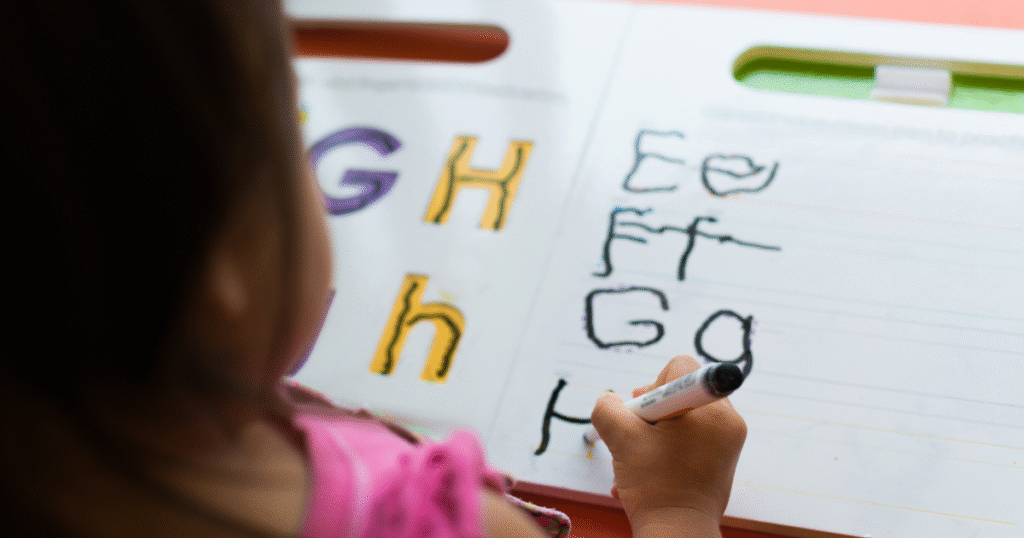
Fine motor skills are the other one that catches parents off guard. Holding a pencil correctly, fitting letters inside small boxes, cutting with scissors, buttoning a jacket — these take months of practice. Kindergarten is now full-day and significantly more academic than it used to be. A child who struggles to hold a pencil is going to find the first few weeks genuinely hard.
Social and Emotional Readiness — When It Gets Real
One statistic changed the way I thought about school readiness entirely: social-emotional skills are more closely linked to first-grade success than family background or cognitive skills.
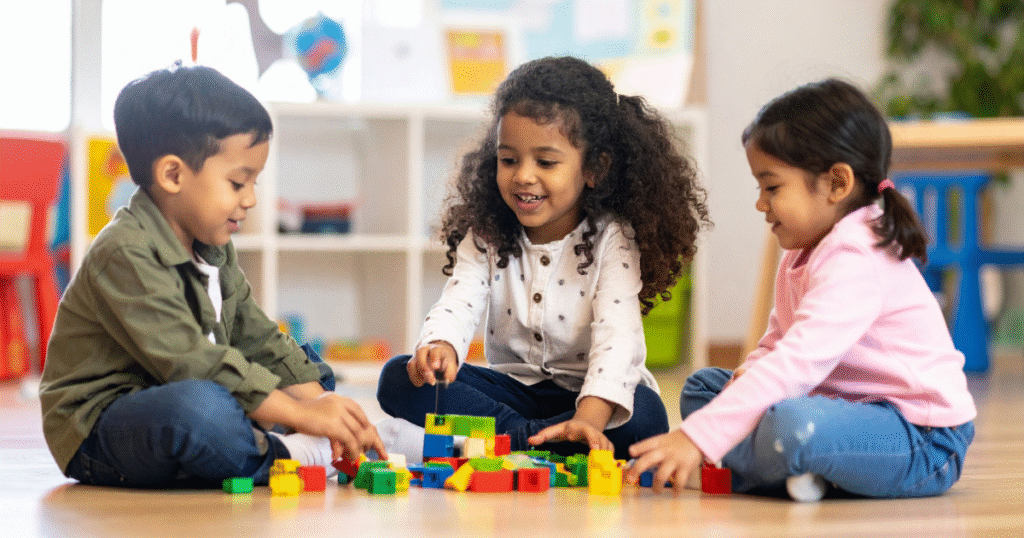
More than whether they know their letters. More than whether they’ve been to pre-K. The child who can manage a transition without a meltdown, take turns without a fight, and sit with a task for 10 to 15 minutes — that child is set up to learn.
I’ve been there — watching Ayla fall apart during transitions and telling myself she’d grow out of it. She will. But practicing it before school starts matters.
During the 2024–25 school year, only 31.5% of kindergartners in Illinois demonstrated readiness in every one of the three areas.
Social-emotional readiness had the highest rates, but language, literacy, and math lagged significantly. 48.6% were ready in language and literacy. Only 35.3% in math. Those numbers are from real classrooms.
Let me be real with you — if your child has big emotions during transitions, that’s not a behavior problem. That’s self-regulation still developing. The goal before kindergarten isn’t to stop the feelings. It’s to practice moving through them — with warnings, with consistent routines, with patience.
The Independence Gap — What Surprised Me Most
Nobody puts this on the pretty kindergarten readiness infographics.
But every teacher mentions the same things. Can she use the bathroom independently — including wiping, flushing, and washing her hands? Can she open her own lunchbox?
Put on and take off her own shoes and jacket? Keep track of her own belongings from drop-off to pickup? These sound small. In a classroom of twenty-five children with one teacher, they are not small at all.
This one thing changed everything for me — I stopped practicing letters at the kitchen table and started practicing independence instead. Getting dressed without help. Opening containers.
Carrying her own backpack. Small everyday skills, practiced consistently, that help a child function in the classroom without constant adult assistance. Pre-K attendance makes a real difference here, too.
Children who participate in pre-K are twice as likely to be kindergarten-ready as those who don’t. In the Houston region by itself, only 39% of eligible 3 to 4-year-olds were enrolled in pre-K in 2023 — down from 41% pre-pandemic. That gap shows up directly in readiness numbers.

When to speak with someone
Most kindergarten Skill gaps are completely adjustable with practice before school starts. But some things are worth discussing with your pediatrician or a child development consultant. If your child regularly cannot follow 2-step directions even after practice, mention it.
If she’s having significant sensory reactions to classroom-type environments — mention it. If speech is still unclear to people outside the family, mention it. And one more thing worth knowing — some parents choose to delay kindergarten entry by a year, which is called redshirting.
About 5% of kindergartners are repeatedly delayed from starting school. Here’s what the research actually says: any academic advantage from the practice of redshirting disappears completely by third grade. It’s not a guaranteed fix. If you’re considering it, talk to your child’s pediatrician and preschool teacher together — not just one or the other.
What Actually Helped Us
Tracking 5 year old milestones practically changed my entire approach to school prep. I made a list — not of what Ayla knew, but of what she could do independently.
Bathroom alone. Jacket on and off. Lunchbox opened. Three-step instructions followed. Ten minutes on one activity without interruption. That became my real readiness checklist. Not ABCs. Not flashcards. Those things matter — but they’re not where most children fall short.
We practiced Changes with countdowns. “Okay, five more minutes and we’re done.”
“Two more minutes.” “One more minute — shoes on.” It sounds tedious. It worked. The meltdowns at transitions dropped significantly within a few weeks.
Play-dough, scissors, threading beads, buttoning her own cardigan — all of it went into our daily routine. Fine motor skills build slowly. They need repetition. Starting earlier is always better than cramming it in the summer before school starts.
Watch your child. Find the real gap — not the one you assumed was there. Then practice that one thing, consistently, until it’s not a gap anymore.
FAQ
1. What does kindergarten readiness actually include?
Way more than ABCs. Readiness involves more than academics — it includes emotional regulation, following several directions at once, staying focused, handling basic self-care independently, and developing early language, math, and motor skills. Most children struggle with at least one of these — usually not the academic part.
2. My child knows her letters and numbers — is she ready?
Maybe — but check the rest of the list too. Can she follow 3-step directions? Manage the bathroom alone? Sit with one task for 10 minutes without redirecting? Those skills predict classroom success more directly than letter recognition does.
3. If she seems immature, is waiting another year for kindergarten the best option?
Get input from her doctor and preschool teacher before deciding. The research shows that any academic advantage from delaying entry disappears by third grade. Delaying isn’t automatically the right answer — and it isn’t automatically wrong either. Get a real assessment first.
4. What are good ways to practice fine motor skills before kindergarten?
Play-dough, child-safe cutting, beads, buttoning, zipping, and drawing neatly inside lines are all helpful activities. These need daily repetition over months, not a week of practice before orientation. Start now, whatever time you have.
5. What’s the one thing most parents miss on the readiness checklist? Independence. Bathroom management, opening a lunchbox, putting on a jacket, tracking their own belongings. In a classroom of 25 children, a teacher cannot stop everything to help one child zip their bag every morning. Practice independence at home — it matters more than most parents realize.
5 year old milestones are a collection of small skills — some academic, some physical, some emotional, some just practical. Kindergarten readiness isn’t one thing. It’s a collection of small skills that add up — some academic, some physical, some emotional, some just practical.
Start with the real checklist. Find the actual gap. And give yourself — and your child — enough time to work on it before that first day.
With love from BabyGuideNest 💛