
4 year old milestones can surprise parents. After the toddler years, many of us expect four to feel easier, and in some ways it is. But four brings its own mix of big language, big friendships, and big feelings.
Most four year olds can tell stories, ask endless questions, and want friends more than almost anything, and they can still fall apart because a sandwich was cut the “wrong” way. This guide covers what’s typical for four year olds, without the scary clinical charts.
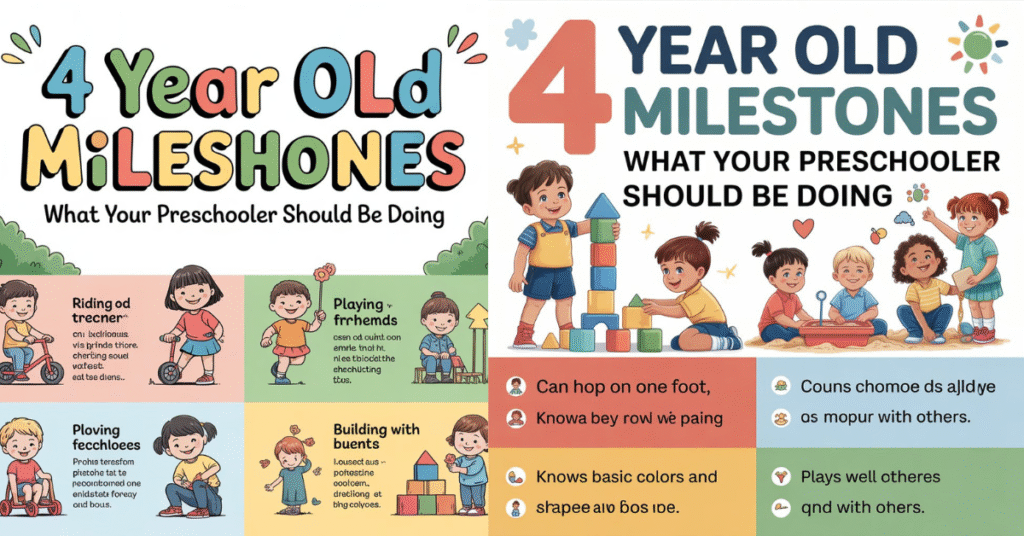
What 4 Year Old Milestones Actually Mean
Let me say this first — milestones are not a checklist to stress over.
They’re a general map of where most children are at a given age, based on decades of child development stages. Doctors use them to spot delays early, when support makes the actual biggest difference. The CDC lists skills that most children (75% or more) can do by this age.
And within that normal range, there’s a lot of room. More than I realized. Five areas are tracked: big body movements, fine hand skills, language, thinking, and emotions. There’s a lot of variation at this age. A child can be really good at one thing, need more time with another, and be right on track with everything else. A four-year-old might tell amazing stories but still struggle to catch a ball—and that can be completely normal.
My daughter was ahead in two, behind in one, and completely average in the other two. Her doctor wasn’t worried at all. That’s just how it works — no kid moves through all five at the same speed.
My daughter was talking in paragraphs at four but still couldn’t catch a ball reliably. Both things were completely fine.
4 Year Old Milestones at a Glance: What Most 4 Year Olds Can Do
Most four year olds can:
- Speak in sentences of four or more words
- Tell you about something that happened during their day
- Name a few colors
- Draw a person with three or more body parts
- Catch a large ball most of the time
- Pretend and play make-believe games with friends
- Pour water or serve themselves food with a little help
- Unbutton some buttons
Every child is different. You can compare this list with the CDC’s full list of 4 year old milestones.
4 Year Old Milestones for Language: How Four Year Olds Talk
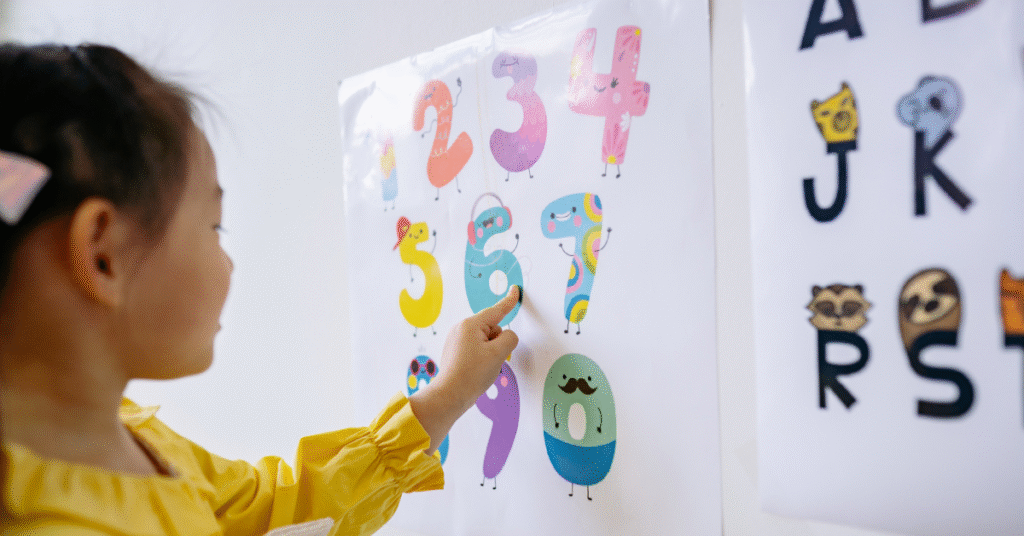
Around age four, language really starts to take off. Kids can tell simple stories from start to finish, ask questions without stop, and confidently share everything with us they’re thinking.
By four, most of the kids are talking in sentences of four or more words. They can normally tell you about their day and follow simple instructions that have a couple of steps.
Some speech getting stuck is normal at this age. A child may repeat the first sound of a word (“c-c-can we go outside?”) because their ideas in brain move faster than their mouth. It usually passes on its own. Try not to finish their sentences, and Refer to your pediatrician if it lasts for months or gets completely worse.
Speech should be understandable to strangers most of the time by four. Not every single word perfectly, but most of it.
If people outside your family have a hard time following what your child is saying, you may want to bring it up with your pediatrician.
Physical Skills of 4 Year Olds

Four-year-olds are often surprisingly coordinated. Many can hop, catch a large ball most of the time, and pour or serve themselves with a little supervision.
Fine motor skills are sharper now — drawing a person with three or more body parts, holding a crayon between thumb and fingers, cutting along a line with scissors, and writing some letters of their name.
Scissors skills come with surprises, and many four year olds have given themselves a haircut. Keep craft scissors supervised. Clean line. Very confident. Completely irreversible.
Bedwetting can still be normal at four. Most children gain full nighttime bladder control sometime between five and seven. If you’re still changing sheets at midnight, you’re not alone. Ask your pediatrician if it troubles your child or continues well past that age.
When sleep slips, behavior, focus, and emotional control usually get harder too.
Social and Emotional Development in Four Year Old
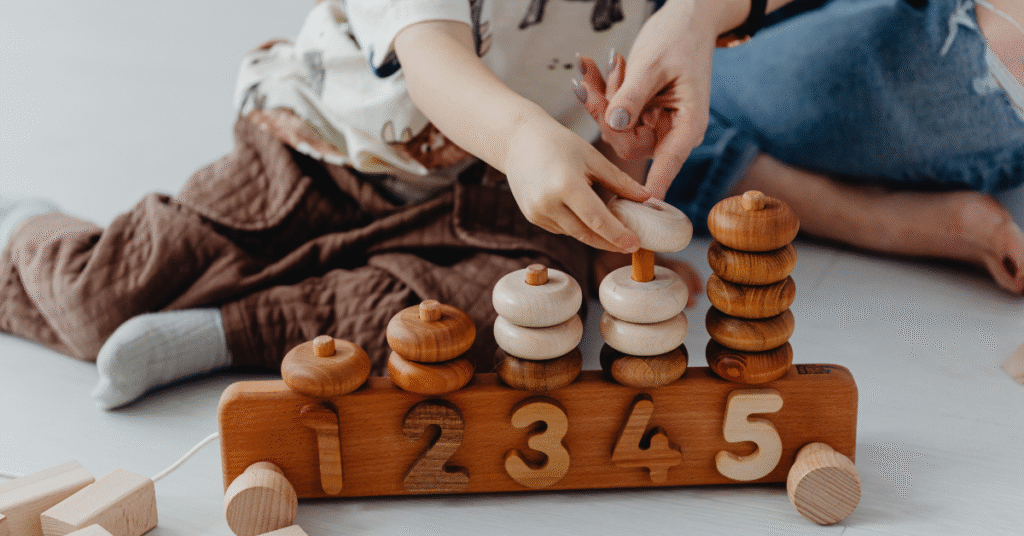
Four-year-olds want friends more than almost anything.
They talk about their friends constantly. They have favorites. They have drama. They come home from preschool with detailed accounts of who said what at snack time. The social world is suddenly very real and very important to them.
Four year olds are still learning right from wrong, and their brains aren’t ready for adult-level moral reasoning. Many “bad choices” are really skills still in progress, so it helps not to take them personally.
Tantrums are still very much present at four. The feelings are enormous. The ability to manage those feelings is still catching up. Separation anxiety can also come back around preschool transitions — it’s not a step backward, just development doing what development does. Let me be real with you — Staying calm during a meltdown usually makes it shorter and easier than matching your child’s energy, even when calm feels impossible.
When to Call the Doctor About 4 Year Old Milestones
Most four-year-olds are absolutely fine. I want to say that clearly.
But some things deserve a conversation with your pediatrician — not to panic, but because early support genuinely changes outcomes. Reach out if your child’s speech is still hard for strangers to understand most of the time. If they show very little interest in playing with other children. If they’ve lost skills they previously had — this one matters at any age. If focus problems are affecting daily play and activities. If separation anxiety is intense and not easing at all over time.
Here’s the thing — the most common mistake parents make is waiting to see if things improve on their own. Sometimes they do. And sometimes, early evaluation would have made everything easier. Your instinct matters. Ask the question.
Next, see what to expect with 5 year old milestones.
What Helps 4 Year Olds Thrive
This one thing changed everything — and it was embarrassingly simple.
Routines. Not rigid ones. Just predictable ones.
Wake up, breakfast, play, lunch, calm time , dinner, bath, bed. When a child knows what happens next, they settle.
The unpredictable days — travel, holidays, schedule changes — were always our hardest days. Every time.
A few other things that genuinely moved the needle:
Giving choices instead of commands.
It’s not “put your shoes on”—it’s “do you want to put your shoes on first or your jacket first?” They feel in control, and you still get what you need. Don’t expect too much, too soon. Four-year-olds don’t need perfect mealtime behavior skills. They don’t need to sit still for long stretches . They don’t need to share every single toy every single time.
Meeting your child where they actually are, developmentally, makes this age more enjoyable for both of you.
Reading together every night. Still our best twenty minutes of the day.
Questions to Ask Your Pediatrician About 4 Year Old Milestones
Going to the four year checkup with a written list helps. Here are common questions.
My child stutters sometimes. Is something wrong?
A: Some stuttering is common at this age and often passes on its own. Don’t finish their sentences. Mention it if it lasts for months or gets worse.
How many words should a four year old know?
A: There’s no exact number. What matters more is whether your child puts words into sentences of four or more words and can be understood.
My child can’t catch a ball. Is that a concern?
A: Skills develop at different speeds. If your child runs, climbs and plays confidently, that’s a good sign.
Is bedwetting still normal?
A: Yes, often until five to seven. A mattress protector and patience help. Ask your doctor if it troubles your child.
When should I call between checkups?
A: If your child loses a skill they once had, reach out to their doctor right away. It’s also worth getting advice if people often struggle to understand your child’s speech or if your child shows little interest in playing with other kids.
Summary
Understanding 4 year old milestones makes this age easier to enjoy. A lot is happening that you can’t always see: language connections, social understanding, and big feelings that slowly become something a child can name instead of just exploding with. Your child needs you to show up regularity and calmly, with a normal routine and a lot of patience. That is enough. 💛