
Bringing your newborn home is a strange kind of happy — exhausted, overwhelmed, and completely in love, sometimes all in the same hour. If you’re feeling a little lost about what’s normal and what needs a phone call to the doctor, that’s exactly why this guide exists. Here’s what to actually expect during your newborn’s first week at home.

Your Newborn’s First Week at Home: What Looks Normal
Don’t be alarmed by how your newborn actually looks in those first days. Puffy eyes, a bit of fine hair on the shoulders or back, and a slightly cone-shaped head from the trip through the birth canal are all completely normal — and it all evens out within a couple of weeks.
Most newborns weigh somewhere around 7.5 pounds (3.5 kg) at birth, though there’s a wide normal range. It’s also completely typical for babies to lose a small amount of weight in the first few days. Feeding frequently, roughly every 1 to 3 hours around the clock, helps get that weight back on track.
Bringing Baby Home: The Car Journey
The first real task of parenthood starts before you even leave the hospital parking lot: getting your newborn home safely.
- Install and test the car seat ahead of time — don’t leave this for the day you’re being discharged.
- Dress your baby in soft, breathable clothing for the ride.
- If it’s cold, put a blanket or coat over the harness straps rather than underneath your baby — bulky layers under the straps can compress in a sudden stop and make the harness less effective.
Your Newborn’s First Week at Home: Sleep and Safe Sleep
Sleep is basically a newborn’s full-time job — expect around 14 to 17 hours a day, broken into 2 to 4 hour stretches. Days and nights get mixed up at first, and that’s normal too, not something you’re doing wrong. Back sleeping remains the safest position, according to the American Academy of Pediatrics.
Many parents end up pacing the hallway at 3 a.m., convinced something is wrong because their baby sleeps for twenty minutes and wakes up screaming. Turns out that’s just… newborns. The day-night confusion is real, and it does pass, usually within a few weeks.
Safe Sleep Starts Here
- Keep it simple — a firm, flat surface like a crib or bassinet is all your baby needs.
- Use a fitted sheet only — no loose bedding, pillows, or crib bumpers.
- Keep the sleep space completely bare — no toys, stuffed animals, or extra blankets.
- Keep the room comfortable and not too warm. Many guides suggest around 68–72°F (20–22°C).
- Swaddling is fine, but always place your baby on their back, and stop swaddling as soon as your baby starts trying to roll over.
- Room-share, but don’t bed-share — this meaningfully lowers SIDS risk.
- Watch for overheating: flushed cheeks, damp hair, or unusual sleepiness are signs to cool things down.
Understanding Your Baby’s Hunger Cues
It’s tempting to assume a crying baby just means “hungry,” but crying is actually a late hunger signal — by the time they’re crying, they’ve usually been trying to tell you for a while.
Early Hunger Cues to Watch For
- Opening and closing the mouth
- Restlessness or squirming
- Clenched fists
- Lip-licking or smacking
- Sucking on hands or fingers
Feeding Tips
If breastfeeding: feed roughly every 1 to 3 hours based on your baby’s cues rather than the clock — newborns don’t read schedules.
If formula feeding: use a sterilized bottle with an exactly measured amount of formula powder, and burp your baby after each feed.
Cluster feeding — where your baby wants to feed much more frequently for a stretch — is completely normal and doesn’t mean anything is wrong with your supply.
With both of my boys, the hardest part of feeding wasn’t too little milk. It was too much. When my milk came in, my breasts became about four times their usual size, and the pain was so intense I couldn’t bear to touch them, let alone feed. It lasted around 8 to 10 days each time, and it came back when I stopped breastfeeding. My own shirts no longer fit, so I wore my husband’s loose kurta.
What helped me was warm, wrung-out towels on my chest, and I had to repeat it often. If you’re dealing with this, you are not alone and it’s not a sign that something is wrong with you. But if the pain is severe, doesn’t improve, or comes with fever, redness, or a hard lump, please talk to your doctor or a lactation consultant, because it can be a sign of infection (mastitis).
Diaper Changes: What the First Few Days Tell You
Your baby’s diapers are one of the clearest signs feeding is going well. In the first day or two, expect dark, tar-like stools called meconium. Over the next few days, this shifts to a lighter, softer, yellowish stool — a genuinely good sign that feeding and digestion are on track.
Once feeding is established, aim for 6 or more wet diapers a day by about day 5 or 6. It’s one of the most reassuring signs that your baby is getting enough milk.
Common Conditions in Your Newborn’s First Week at Home
Jaundice
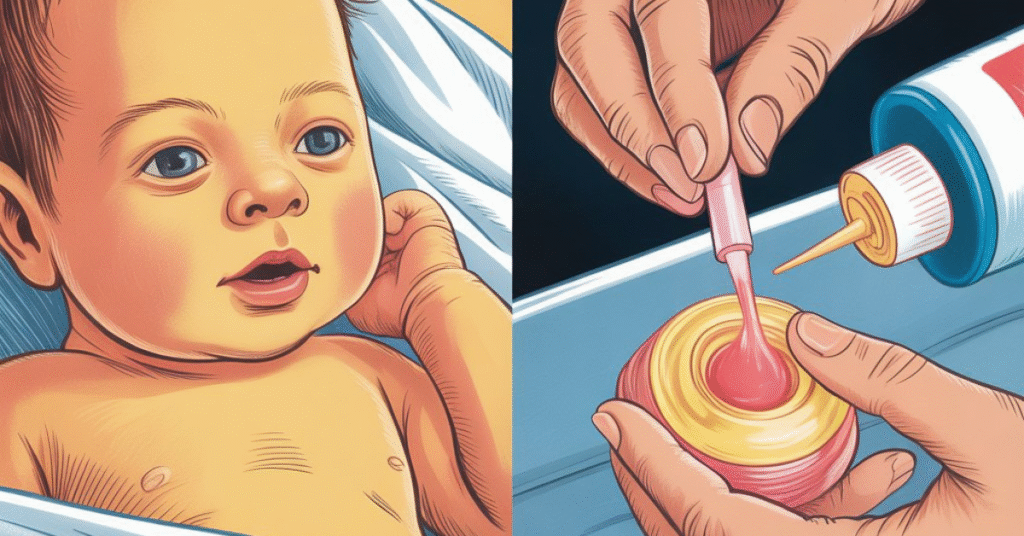
Jaundice is extremely common in newborns. It happens because a baby’s liver is still maturing and can’t yet fully filter a substance called bilirubin out of the blood. In most cases, it resolves on its own within the first week or two. That said, call your baby’s doctor if the yellowing appears in the first 24 hours, gets darker, or spreads to the belly, arms or legs. Don’t wait it out. Most babies have a first check-up scheduled between day 3 and day 5, when bilirubin levels get checked.
Umbilical Cord Care
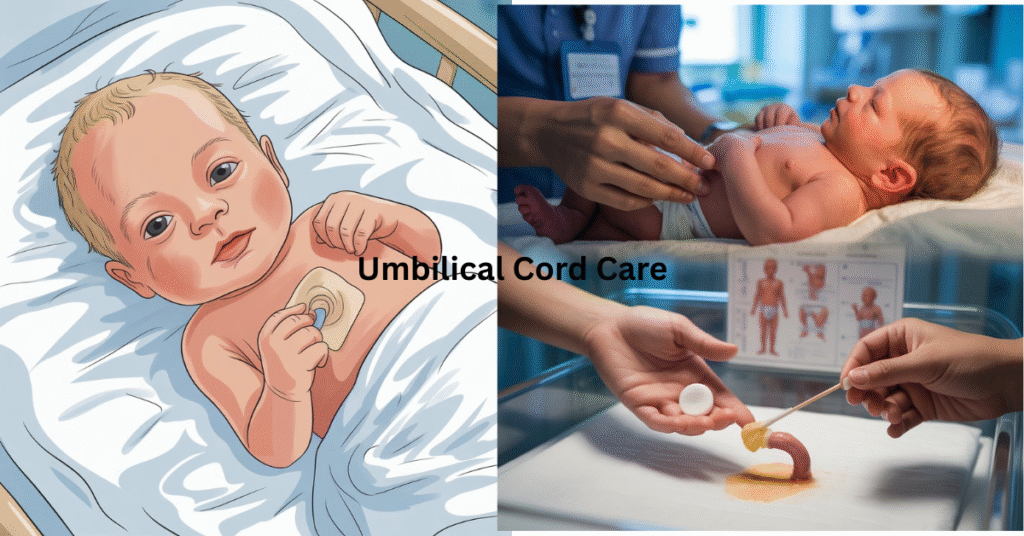
Caring for the umbilical cord stump is simpler than it sounds: keep it clean and dry, let it air out, and fold the diaper down below it to avoid trapping moisture. There’s no pain involved in cleaning around it — the stump has no nerve endings. It typically falls off on its own within 7 to 14 days. Skip the powders and oils; they don’t speed things up and can trap moisture instead.
Once the cord stump has healed, you can start regular baths — here’s our step-by-step newborn bathing guide to help you get comfortable with it.
When to Call the Doctor in Your Newborn’s First Week at Home
Call your pediatrician if you notice any of the following:
- A fever of 100.4°F (38°C) or higher — this always needs immediate medical attention in a newborn
- Yellowing that appears in the first 24 hours, gets darker, or spreads to the belly, arms or legs
- A hard or swollen belly
- Blue-tinged skin
- Coughing or choking during feeds
- Crying that sounds like pain, not just fussiness
- Refusing to feed or drinking noticeably less
- Breathing that seems difficult, or brief pauses in breathing
- Noticeably fewer wet diapers than the 6 or more expected by day 5 or 6
- Unusual limpness or lack of responsiveness
- A sunken soft spot (fontanelle) on the head
When Your Baby Won’t Stop Crying
Crying is simply how your baby communicates — it’s not a sign you’re doing something wrong. Start with the basics: hunger, a wet diaper, tiredness, gas, or general discomfort.
If you’ve checked all of that and the crying continues, these five things genuinely help a lot of parents:
- Swaddling — wrapping your baby snugly in a soft blanket can be surprisingly calming.
- Side or tummy-down hold — only while you’re awake, holding and watching your baby, this position can settle them faster than lying flat. Never put your baby to sleep on their side or tummy.
- Shushing or soft singing — steady, rhythmic sound genuinely soothes newborns.
- Gentle rocking or swaying — slow, repetitive motion mimics the feeling of the womb.
- Sucking — a feed, clean finger, or pacifier can have a natural calming effect.
Many babies have a stretch every evening, often around week two, where nothing works: not feeding, not rocking, nothing. Some babies just need to “get it out.” It doesn’t last long, but in the moment it feels endless.
Understanding Sleep Patterns in Your Newborn’s First Week at Home
Getting a handle on your baby’s sleep patterns makes a real difference for both of you — a rested baby and a rested parent make that first week considerably more manageable. Start a simple, consistent sleep routine early so your baby slowly begins to recognize sleep cues. And take the advice you’ve probably already heard a dozen times: rest when your baby rests. Your own energy directly affects how well you can care for your newborn through these early, disorienting days.
A Note for New Moms: Your Nutrition Matters Too

During your newborn’s first week at home, if you’re breastfeeding, your body needs extra support too — this isn’t optional self-care, it’s practical fuel — this isn’t optional self-care, it’s practical fuel. That generally means a few hundred extra calories a day, plenty of fluids (drink to thirst), and nutrient-dense foods like oats, nuts, eggs, and leafy greens. Your doctor can tell you what’s right for you.
Honestly, in those first days many new moms survive on toast and whatever is within arm’s reach on the couch. It’s not about being perfect, just about getting something in.
Bonding With Your Baby
Bonding doesn’t need to be complicated. A few simple habits go a long way:
- Skin-to-skin contact — simple, gentle touch that both of you benefit from.
- Talk to your baby — your voice is one of the most recognizable and comforting sounds they know.
- Tummy time — a few supervised minutes a day helps build early strength.
Your Newborn’s First Week at Home: FAQs
Q1: How often should a newborn feed during their first week at home?
Every 1–3 hours, roughly 8–12 times a day. Cluster feeding — feeding more often for a stretch — is completely normal.
Q2: How many hours does a newborn sleep?
Around 14–17 hours a day, broken into 2–4 hour stretches rather than one long sleep.
Q3: Is cluster feeding normal?
Yes, completely — it doesn’t mean your milk supply is low.
Q4: When does the umbilical cord stump fall off?
Usually within 7–14 days. Keep the area dry and clean, with the diaper folded down below it.
Q5: Is it normal to feel overwhelmed during your newborn’s first week at home?
Completely. Sleep deprivation, hormone shifts, and the sheer learning curve of caring for a newborn hit everyone differently. If those feelings persist or feel unmanageable past the first couple of weeks, it’s worth talking to your doctor about postpartum mood support. If you ever have thoughts of harming yourself or your baby, get help right away.
Final Thoughts
Your newborn’s first week at home is a steep learning curve, and nobody gets it perfect. Feed often, sleep safely, watch the warning signs, and call your doctor when something feels off. You’re learning together, and that’s enough.
A Quick Note
I’m Hafiza Sumaira, a mom of two, not a doctor or a pediatrician. This guide shares general information from trusted health sources and it is not medical advice. If something feels wrong with your newborn, call your pediatrician or go to the ER. Don’t wait to be sure.