
Implantation bleeding vs period is one of the most confusing early pregnancy questions. Is this spotting a sign of pregnancy — or just my period?
Since both can happen close together, knowing the difference really helps. Beyond biology, this question evokes a very human feeling, particularly for those who have been waiting a long time for good news. Even a small area of blood can occasionally turn into a large, hopeful question.
Let’s break it down calmly and clearly.
What Is Implantation Bleeding? (And Why Does It Happen?)
To understand implantation bleeding, it helps to know what happens inside your body in the days after conception.
A zygote is created when an egg and sperm combine. This zygote moves over the course of six to twelve days in the direction of the uterus. They divide very quickly in this journey: one turns into two and two into four and this process goes on, and the result that occurs at the end of this division is known as embryo.
When they reach their required place they find the endometrium, a thick, blood rich lining that is actually home of essential nutrients. Here embryos get the required nourishment from mother blood for survival and for development.
To anchor itself, the embryo burrows into this lining. This is called implantation. As it pushes in, a few tiny blood vessels can break, causing a very small amount of bleeding. That is implantation bleeding. It is generally considered harmless and usually stops on its own.
Signs of Implantation Bleeding
| Feature | Implantation Bleeding |
| Timing | About 6–12 days after conception |
| Duration | 2–3 days |
| Flow | Very light — often no pad needed |
| Color | Pink or brown (not bright red) |
| Clots | None |
| Pain | Mild pelvic pressure or slight cramps — or nothing at all |
Not all pregnancies result in implantation bleeding. Only 15% to 25% of women experience it, according to research. If you don’t experience it, that is completely normal — it does not mean anything is wrong.
What About Your Period?
The rhythm of your menstrual cycle is familiar. It usually starts out light, gets heavier, and then gradually gets lighter. Period cramps can be more severe because your body, particularly your uterus, is contracting to fully shed its lining.
| Feature | Period |
| Timing | Regular cycle dates |
| Duration | 3–7 days (varies by person) |
| Flow | Moderate to heavy |
| Color | Red (bright or dark) |
| Clots | Common |
| Pain | Stronger cramping due to uterine contractions |
Implantation Bleeding vs Period: Side-by-Side Comparison
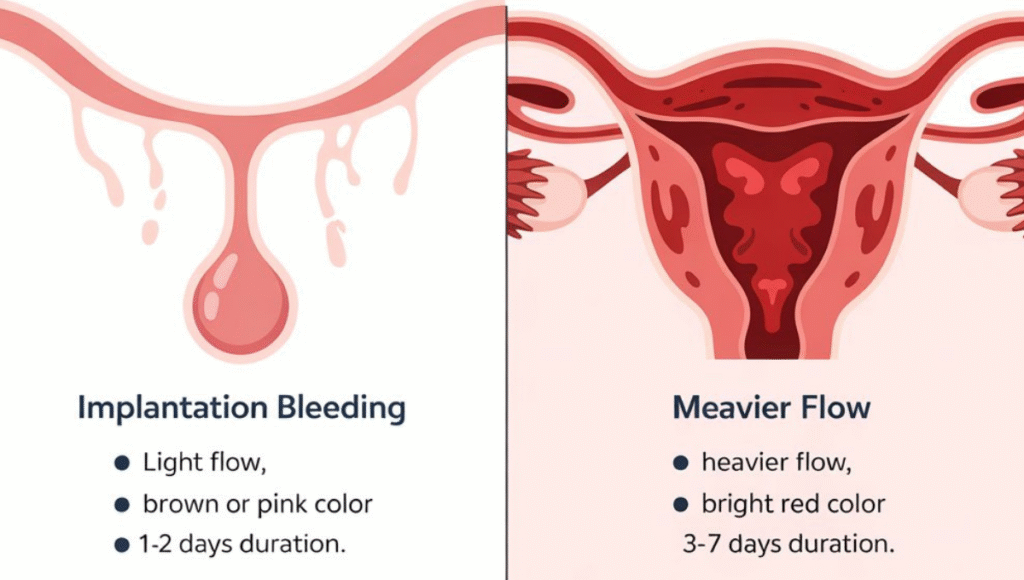
This implantation bleeding vs period comparison table makes the differences easy to see. Here’s where the real difference lies — and it comes down to flow, color, and clots.
| Feature | Implantation Bleeding | Period |
| Cause | Embryo burrowing into uterine lining | Uterus shedding its lining |
| Flow | Very light spotting | Moderate to heavy |
| Color | Pink or brownish | Red (bright or dark) |
| Clots | None | Often present |
| Cramping | Mild or absent | Moderate to severe |
| Duration | 2–3 days | 3–7 days |
Why the color difference?
During a period, the uterus contracts strongly, pushing fresh blood out quickly — so it stays bright red. With implantation bleeding the flow is so slow that the blood has more time to react with oxygen, which makes it look pink or brown.
Why no clots with implantation?
The embryo is simply settling into the lining, so the uterus is not contracting or shedding tissue. Because the flow is so light, clots usually don’t form.
Overlapping Symptoms — The Real Confusion
This is where it gets complicated. PMS and early pregnancy share a number of symptoms:
- Bloating
- Mood swings
- Weariness
- Breast tenderness
- Slight cramping
- Constipation
Honestly, you can’t tell if you’re pregnant just from symptoms because they feel so similar to your usual period signs. Your body kind of sends the same signals in both cases. That’s why tracking your cycle with an app really helps—you start to notice what’s normal for you and what’s not.
So, How Do You Know for Sure?
Pregnancy test with pregnancy kit and with blood test is the easiest way to know what is actually going on:
- When the process of implantation happens women body start making hormone HCG that actually show on the pregnancy kit.
- Just don’t rush into testing.
- Giving it time—after your missed period is usually best.
- If your cycle is unpredictable, wait around 3 weeks after unprotected sex.
- When you take the test too early then the result may not be correct because the level of hormones is still low.
When You Should Get Medical Advice
Although light spotting following implantation is typically normal, some symptoms shouldn’t be disregarded.
Seeing a doctor is recommended if:
- The bleeding feels heavy or keeps increasing
- The color is bright red and persistent
- You’re dealing with strong cramps or pain
- It continues beyond a few days
- You’ve already tested positive and then experience heavy bleeding
- You feel sharp pain on one side of your lower belly, dizziness, or shoulder pain — get urgent medical help
If something doesn’t feel right, don’t wait—getting medical advice is always the safest option.
Frequently Asked Questions
Q1: Can implantation bleeding be mistaken for a light period?
A: Definitely. The difference is that implantation bleeding doesn’t get heavier and has no clots.
Q2: How soon after implantation can I take a pregnancy test?
A: It’s best to wait a few days after spotting stops, then take the test after your missed period. Use first-morning urine for the most accurate result since hCG is highest then.
Q3: Does implantation bleeding happen in every pregnancy?
A: No. It only happens in some cases, and skipping it is completely normal.
Q4: Can stress cause similar spotting?
A: Yes, which is why symptoms alone aren’t enough—always confirm with a test.
Quick Summary
Understanding implantation bleeding vs period can help you read your body signals clearly.
- What you’ll notice is usually very light, short-term spotting, pink or brown in color, without any clots.
- Periods can include clots and are heavier, longer, and bright red.
- Overlapping symptoms like cramps and fatigue can’t tell you which is which
- Only a pregnancy test taken at the right time gives you a reliable answer
- Not everyone gets implantation bleeding, so not having it doesn’t mean anything is wrong
If your test is positive, our pregnancy week by week guide shows what to expect next.