
How to talk to your kids so they actually listen isn’t about volume or repetition —
it’s about the small conditions that either open communication or shut it down.
I used to shout Ayla’s name from the kitchen while she was in the TV room and then get frustrated that she wasn’t responding.
How to talk to your kids so they actually listen was not a question I’d been asking myself — I’d been asking why Ayla wasn’t listening. A completely different question. One puts the problem with her. The other puts everything where it belongs.

One morning I counted. Five things in one breath — shoes, bag, cousin, hurry, water bottle. She looked at me, put on her shoes, and stood there. That was it. I said it again, louder. Still just the shoes. That was it. One out of five. So I repeated it. Louder. Like the problem was volume and not the fact that I’d given her five things at once. And then the afternoon of the “you’re fine” — she was crying about something that felt small to me, and I said it automatically. “You’re fine. It’s nothing.” She cried harder. It hit me right there. I’d just told her that what was actually real to her wasn’t real. And then I thought about why she’d gotten quieter about the things that bothered her. Those two things were connected, and I’d missed it totally.
Three separate moments. Three separate problems. All of them are mine.
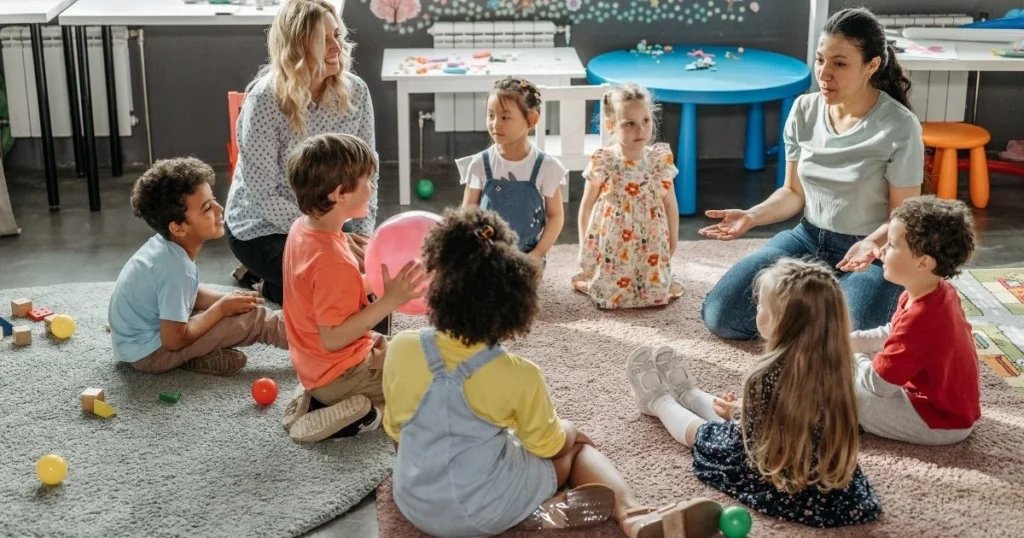
What Talking So Kids Listen Actually Means
It’s not a trick. It’s not a technique you apply once and check off. Before anything else — check the conditions. Is she hungry? Tired? Has she just come off a screen? Is she already in the middle of something emotionally? If yes to any of those — whatever you’re about to say is not going to land. Not because she’s difficult. Because her brain is genuinely not available right now.
Four decades of research on parenting programs keeps coming back to the same finding. Connection and communication — done well — improve everything. Behavior. Relationships. How kids do at school. How they handle emotions. All downstream from this one thing.
And children consistently prefer two-way communication over one-way adult instruction — meaning the lecture, the repeated command, the direction from across the room — these don’t work because children are defiant, but because that’s not how children actually take in information.
Here’s the statistic that genuinely floored me — 93% of parents believe their child feels comfortable sharing feelings with them. But 38.8% of severely distressed children reported not talking to anyone. And among the ones who did seek help, only 41.8% chose to speak to a parent. There’s a gap between what we think is happening and what’s actually happening — and it lives in the small daily moments we don’t notice.
What I Was Actually Doing Wrong Without Realizing It
I didn’t even think about it until someone pointed it out.
My mother-in-law visited and watched me call Ayla from the kitchen three times in a row. Then she quietly said — “She can’t hear you properly from there.” Not the words. The competing noise, the distance, the fact that Ayla’s attention was somewhere else entirely. I was delivering instructions into an environment where they couldn’t land, and then treating the non-response as defiance.
Here’s what nobody told me — physical proximity changes everything. Getting up, walking to where Ayla was, crouching to her level, making eye contact, and then saying the one thing I needed her to do — that got a response almost every single time. Not because I’d found a magic phrase. Because I’d created the actual conditions for communication.
I also stopped giving three to five instructions in one sentence. “Shoes on” lands. “Shoes on, grab your bag, tell your cousin, hurry up, and don’t forget water” does not land — it lands as noise. One instruction. Wait for it to happen. Then the next one. This felt impossibly slow the first week. It was faster overall because I stopped repeating myself four times.
The Five Instructions Problem — When Things Changed
The morning I said five things and got one result was the morning I actually counted what I was asking.
I’ve been there — running behind schedule, trying to compress ten minutes of preparation into three, loading Ayla up with everything at once and then being genuinely baffled that she only caught the first item. She wasn’t ignoring me. She was doing exactly what her brain could hold — one thing — and the rest had evaporated before she’d finished the first.
One thing. That’s it. One concrete thing, said clearly, with enough time for it to actually land. A preschooler’s brain is not a small adult brain — it works completely differently and holds a fraction of what mine does. I knew this intellectually. I kept communicating as if it wasn’t true.
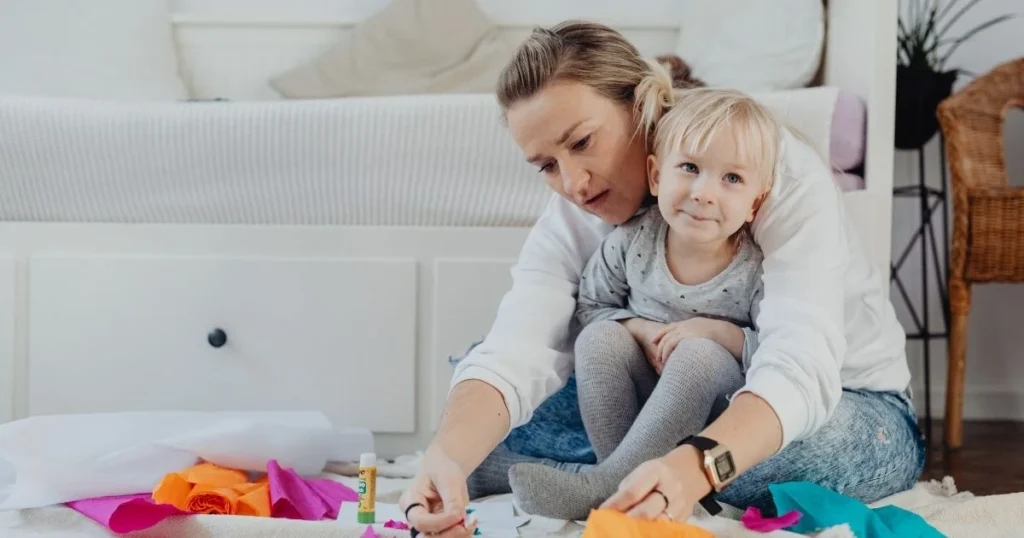
The teach-back check changed things practically — instead of assuming she’d understood, I’d ask, “What are you going to do first?” One question. It told me immediately whether the instruction had landed or whether I needed to simplify it further. Most of the time, it had landed. When it hadn’t, I found out before we were both frustrated about it.
Let me be real with you — only 68.6% of U.S. children report being able to share ideas or discuss important matters with their parents. The national target for 2025 is 73.1%. We haven’t hit it. Meaning roughly one in three children don’t feel they can really talk to their parents. That number lives in the small daily moments — the dismissed feelings, the interrupted sentences, the “you’re fine” that wasn’t fine.

The “You’re Fine” Problem — What Surprised Me Most
This one undid more than I realized at the time.
“You’re fine.” “It’s nothing.” “Stop crying, there’s no reason to be upset,” I said versions of these continuously, not to dismiss Ayla, but because I actually believed reassurance was what she needed. It wasn’t. Reassurance tells a child what to feel. Acknowledgment tells a child that what they feel is real.
The sequence that actually works — pause, observe, acknowledge the feeling, clarify what happened, then set a limit or offer choices if needed. Not immediately fix it. Please do not modify it. First, acknowledge it. “You’re really upset right now.” That’s it. That sentence alone, said without judgment, de-escalates more than any explanation I’ve tried.
Honestly, this surprised me too. I thought connection and correction were sequential — connect first, then correct. The research says connection isn’t just first. It’s the condition that makes correction possible at all. Without it, correction lands as an attack. With it, it lands as guidance.
High-quality listening requires three things — attention, warmth, and understanding. Not just hearing the words. All three. I’d been giving Ayla partial listening for years without knowing it was partial.
And this one stopped me completely — phrases like “stop that” or “if you don’t do this, then…” actually activate a child’s fight-or-flight brain response. The brain shifts into defense mode. Listening and cooperation drop. I’d been using those phrases constantly, wondering why nothing was landing. And we’re spending less time talking to our kids than we were five years ago. Daily chatting — down from 90.3% to 70.2% since 2019. Reading together, playing together — both dropped significantly. The small conversations are disappearing, and those are exactly where listening gets built. Daily reading — down 20 percentage points. Daily play — down 25 percentage points. We’re spending less time in the small conversations than we were five years ago, and those small conversations are exactly where listening gets built.
When the Communication Problem Needs Outside Help
Most parent-child communication issues respond to changed habits, not professional intervention.
But if your child has stopped talking to you about anything meaningful, consistently shuts down when you try to connect, shows signs of anxiety or withdrawal around communication, or if there’s been a significant disruption in the family — divorce, loss, a major change — that’s worth a conversation with your pediatrician or a family therapist. Not because something is catastrophically wrong, but because patterns established in childhood become the template for every relationship that follows.
Communication is a skill for the child too. If there are concerns about language development, comprehension, or social communication — those belong with a speech-language professional, not just a parenting adjustment.
What Actually Got Us Through It
Learning how to talk to your kids so they actually listen came down to three
small habits — not one big technique.
Three habits that changed things more than any technique I’d read about.
Get up and go to her. Every single time I need her to do something. Not shout it from wherever I am. Walk there, get to her level, make eye contact, say the one thing. This alone cut the repetition cycle almost completely within a week.
One thing at a time. One instruction. Wait. Then the next. Excruciating the first few days. Genuinely faster overall because she actually did the things instead of standing there overwhelmed while I repeated everything louder.
Acknowledge before anything else. Whatever she brings to me — frustration, upset, excitement, complaint — the first thing out of my mouth is some version of “I can see that.” Not “you’re alright.” Not ‘that’s not a big deal.’ Just knowing that what she’s experiencing is real. That one habit changed the temperature of our house more than anything else I’ve tried.
Ask before advising. Dr. Sue Varma — psychiatrist, also a mom — says ask before you fix. “Do you want any person who gives any instruction? Do you just want me to listen?” One question. It changes everything about how the conversation is going. I started doing this with Ayla even at three. Most of the time she just wanted me to hear it. The times I jumped straight to fixing — she’d already stopped talking.
When things get tense, I stopped saying “you never listen.” Swapped it for something specific — “When I called you three times, and you didn’t come, I felt like I wasn’t being heard.” Same situation. Completely different landing. She doesn’t shut down. She actually responds. It’s specific. It’s calm. Her brain doesn’t flip into survival mode. She can actually hear it.
FAQ
1. When I talk to my child, why doesn’t my child pay attention or give an answer to me?
Normally, conditions, not resistance. Are they mid-screen, hungry, tired, or emotionally overloaded? Is the instruction coming from another room? Are you giving multiple directions at once? Changing the conditions almost always changes the response.
2. How many instructions can a young child hold at once?
One. Maybe two for older children. One thing at a time. Genuinely one. Not two with a pause in between. One. Wait for it to happen. Then the next. I know it sounds too simple. It works in a way that five-at-once never did.
3. Why is it considered a problem to tell my child “you’re fine” when children are going to feel upset sometimes anyway?
It tells them their feelings aren’t real. Children whose feelings get dismissed consistently stop bringing those feelings to their parents — which means you lose the connection before correction becomes possible. First, I need to know, every time.
4. How do I get my child to listen without shouting?
Move closer. Get to their level. Make eye contact. Then say one thing. Volume is almost never the missing ingredient. Proximity and attention are.
I still catch myself shouting from the kitchen sometimes. Still start a sentence with five things occasionally. Yet say “you’re fine” when I’m tired, and she’s upset, and I just want it to be fine.
The difference is I catch it faster now. And when I don’t — I go back, crouch down, and try again. That part she notices too.
With love from BabyGuideNest 💛
A Quick Note
Just a mom here, not a child doctor or communication expert. Everything in this post comes from my own experience and research I’ve read along the way. If communication breakdown feels significant — persistent withdrawal, anxiety around talking, or major family disruption — please talk to your pediatrician or a family therapist. A blog can give you tools. A professional can see what’s actually happening.