
A breastfeeding guide for new moms rarely mentions the part that matters
most — up to 92% of mothers face at least one problem in the first week,
and almost all of it is fixable. First feed. Ayla latched. I held on tightly to the bed rail with my free hand.
That wasn’t what I expected from the breastfeeding guides I had read as a new mom. The books said “mild initial discomfort.” The nurse said, “You’ll get used to it.” I moved her head in agreement because she was the nurse and I was the person who had never done this before and didn’t know yet that “you’ll get used to it” is not the same thing as “this is fine.”
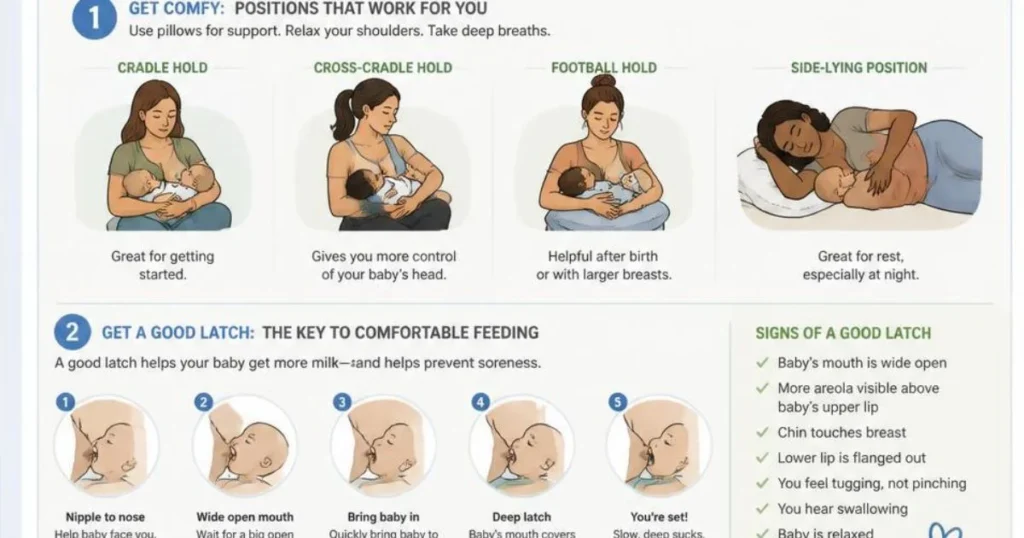
Went home. I tried every position I’d saved on YouTube. Cross-cradle, football hold, side-lying — Ayla and I worked through all of them with varying degrees of failure. She’d latch, unlatch, fuss, latch again. By day three, I was cracked in two places, running on no sleep, and completely unsure whether anything I was doing was correct.
Then I called a lactation consultant. She watched one feed. Fixed the latch in about four minutes. Four minutes. Three days of pain, and it was a technique problem the entire time.

What Breastfeeding for New Moms Actually Means
Not natural. Not instinctive. A skill. For both of you.
Up to 92% of mothers face at least one breastfeeding problem in the first week. Not the unlucky ones. Not the ones doing something wrong. Nearly everyone. That number exists, and nobody leads with it because it would sound discouraging. But actually knowing it going in would have helped me enormously. Most early problems are fixable. That’s the other half of the statistic. In one study, improper latching was found in 72% of participants and dropped to 10% after one proper education session. The body usually isn’t the problem. The technique almost always is.

The First Week — What I Noticed
Everything hurt in ways I hadn’t anticipated, and nobody had described honestly.
Sore nipples hit 80 to 90% of new mothers. Engorgement — when milk comes in around days 2 to 5 — somewhere between 33 and 60%. I woke up on day three genuinely alarmed. Overnight my body had decided to produce what felt like an unreasonable amount of milk, and none of it was moving efficiently because Ayla still hadn’t nailed the latch.
Here’s what nobody told me — engorgement makes latching harder. Breast gets firmer, nipple flattens, baby can’t get deep enough purchase. More shallow latch, more pain. Exactly the wrong direction. The fix — hand expresses a small amount before a feed to soften things enough for her to get on properly. I learned this on day four. It would have changed day one.
I was also confusing supply worries with latch problems. These are different. I spent a week convinced I wasn’t producing enough when the actual issue was that a shallow latch meant she wasn’t transferring efficiently. Different problems. Different solutions. Same amount of unnecessary panic.
Weeks Two to Six — When Things Shifted
Around week two, something changed. Not overnight. Just — noticeably.
Ayla got better. I got better. Feeds got shorter and less exhausting. The lactation consultant had said, “two to three weeks before it starts feeling easier” and I had not believed her at the time. She was right.
I’ve been there — at day ten, sitting through a feed at 2 am thinking this will always be this hard. It doesn’t stay this hard for most people. The steep part of the learning curve is genuinely steep. The other side of it is real.
Week four brought a blocked duct. Hard, painful lump, one side, worse with feeding rather than better. Heat before, massage during, feed frequently on that side. Resolved in 48 hours. If I’d ignored it another day or two — mastitis.
Breast inflammation or infection can affect around 10% to 33% of breastfeeding mothers, and it’s not something you should simply wait out. If you develop flu-like symptoms along with breast pain, it’s important to contact your healthcare provider, as antibiotics may sometimes be needed. The warning signs are always there a day or two before. Most people miss them because they’re already so tired.
What Surprised Me Most
Two things stopped me when I read them.
First — 66% of mothers in one study had short or retracted nipples contributing to latch problems. More than half. Most hadn’t been told this was a factor. A flat or inverted nipple doesn’t mean breastfeeding is impossible — it means the standard approach won’t work without adjustment. This is the kind of thing that should be in every hospital discharge conversation and rarely is.
Second — nearly 59% of mothers reported feeling like they weren’t producing enough milk. But perceived low supply and actual low supply are completely different things. Most mothers who feel they aren’t making enough are making plenty — the baby feeds constantly because that’s what newborns do, not because there isn’t enough. Frequent feeding is demand signaling. More demand, more supply. The math is counterintuitive until you understand it.
Honestly, this surprised me too. I nearly supplemented with formula in week one because I was sure I wasn’t producing enough. My lactation consultant did a weighted feed — Ayla was getting exactly what she needed. The problem was my perception, not my production.
When to Stop Waiting and Get Help
Two to three days of worsening nipple pain. That’s the window. Not two weeks. Not when it becomes truly unbearable. Two to three days of getting worse, and you call a lactation consultant.
Not a nurse who says push through. Not a relative with opinions. A trained lactation consultant who watches an actual feed, assesses the actual latch, and gives you corrections based on what they see.
Hard, painful lump — address within 24 hours. Heat, massage, frequent feeding, monitor. Fever and flu symptoms alongside breast pain — mastitis, needs antibiotics, call your provider that day.
Cracked or bleeding nipples are not something to push through. They’re information. The latch is wrong, and it needs fixing. A nipple shield might help temporarily, but it’s not a solution — getting the latch right is the solution.
What Actually Got Us Through It
Every breastfeeding guide for new moms I’d read before Ayla was born skipped
the one thing that actually helped — getting real help early, not weeks in.
Three things. Real ones.
The lactation consultant on day three. That single hour changed more than everything else combined. Someone watching a real feed, giving real corrections in real time — that cannot be replicated by a YouTube video or a book diagram. If your hospital offers lactation support before discharge, use it. If they don’t, find one independently and go in the first week.
Hand expressing before engorged feeds. Thirty seconds to soften the areola enough that she could actually latch properly. This is mentioned in passing in most guides. It should be the first thing anyone tells you when milk comes in. It made every engorged feed significantly less painful. Most parents skip it because nobody explains specifically enough why it matters.
Stopping the assumption that pain means it’s working. Pain in breastfeeding is almost always a signal something needs to change. Not a rite of passage. Not something to earn your way through. A signal. The mothers who push through pain without addressing it are the ones who stop earlier than they wanted to — because pushing through doesn’t fix anything.
FAQ
1. Is breastfeeding supposed to hurt?
Mild initial discomfort in the first few seconds can happen. Sharp, lasting pain, cracked nipples, bleeding — those are not normal and not something to endure. They mean the latch needs fixing. It’s almost always fixable with complete and good help.
2. How do I know if my baby is actually getting enough?
Count wet diapers — at least 6 per day after day 4. Steady weight gain at check-ups. Regular feeding doesn’t mean not fulfilling the tummy. Newborns feed regularly after a small break because their stomachs are small and digest the milk quickly.
3. What do I do about Painful breast fullness?
Feed frequently, hand-express small amounts before feeds to soften the areola, warm compress before and cold after. Keep feeding — stopping makes it worse. If it doesn’t improve within a day or two, call your lactation consultant.
4. Blocked duct versus mastitis — what’s the difference?
A blocked duct is a hard, tender lump. Mastitis is when that becomes infected — fever, chills, flu-like symptoms alongside the breast pain. Blocked ducts need addressing within 24 hours to prevent that progression. Breast inflammation needs antibiotics as soon as possible.
5. What if breastfeeding isn’t working out for you?
Fed is best. If you’ve gotten proper support and it still isn’t working, formula is a completely valid choice. A nourished baby and a mother who is coping — that’s the goal. If you want to keep trying, get specialist help before deciding to stop. Many situations that feel impossible are actually fixable with the right person watching.
That first week was harder than the birth. Harder than the sleep deprivation. Harder than anything I had prepared for. The lactation consultant appointment on day three was also the most useful hour of early parenthood. Four minutes to fix something three days of pain hadn’t fixed.
Get help early. Pain is information. And it almost always gets easier.
With love from BabyGuideNest 💛
A Quick Note
Just a mom here, not a lactation consultant. Everything here comes from my own experience and research I’ve read. If breastfeeding is painful or not working — please reach out to a certified lactation consultant or your healthcare provider. The right support makes a real difference, and you deserve access to it early, not after weeks of struggling alone.