
How Does Implantation Feel? Cramps, Timing & What’s Normal
How does implantation feel — I typed that exact phrase into Google at 2am while my husband slept beside me, three Reddit threads deep into other women’s symptom timelines.
I was 8 days past ovulation. Earlier that day, I felt a tiny twinge low in my belly and immediately convinced myself something significant was happening. I checked my period tracker app every twenty minutes, like staring at it harder would reveal more information. By midnight, I had read enough forum posts to diagnose myself with at least four different outcomes.
Then, a few hours later, that same twinge came back stronger, and I sat completely still and announced to absolutely nobody in the room, “I think it’s happening.” It was gas. I think it’s important to be good and perfect about that. It was gas, and I had built an entire emotional narrative around digestion.

What Implantation Actually Means
https://babyguidenest.com/implantation-bleeding-vs-period-how-to-tell-the-difference/Implantation happens when a fertilized egg attaches to the lining of your uterus — typically 6 to 10 days after ovulation, with most sources pointing to 8 to 10 DPO as the average window.
Here’s what nobody told me — there’s no actual scientific proof that implantation itself can be physically felt. The embryo at this stage is roughly the size of a dust mite. You cannot feel cells dividing any more than you can feel your hair growing. What people describe as “implantation cramps” happen around the same time implantation occurs, but the cause-and-effect link isn’t something science has actually confirmed.
That matters because so many of us — myself included — go looking for a feeling that may not exist in any verifiable way, and then panic when we don’t feel it.
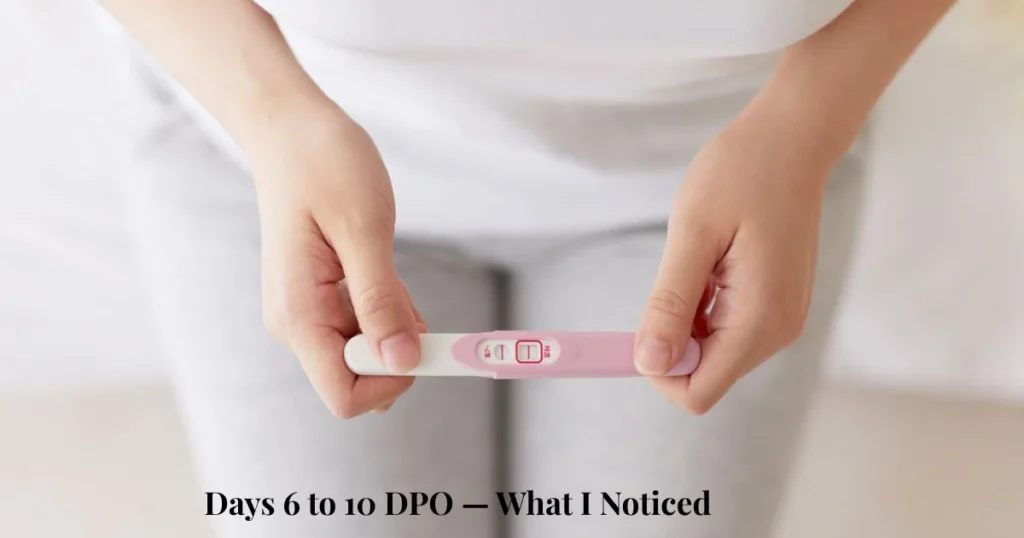
Days 6 to 10 DPO — What I Noticed
This is the window most women fixate on, myself absolutely included, that cycle.
Around 30% of pregnant women report feeling implantation cramps somewhere in this range, though other research puts the number closer to 25%. That means the majority of women — somewhere between 70 to 75% — feel nothing at all and go on to have completely normal, healthy pregnancies.
I’ve been there — convinced that not feeling anything meant something was wrong. Going through implantation cramps is common, but not experiencing them is just as normal.
The Lack of any symptoms tells you nothing either way.
Honestly, this was unexpected for me, too. I assumed feeling cramps meant pregnancy was more likely, and feeling nothing meant it wasn’t going on . Neither assumption holds up.
What the Cramps Actually Feel Like — When Women Describe Them
For the roughly one in four to one in three women who do notice something, the description is fairly consistent.
Mild, prickly, sometimes tingly sensations — milder than period cramps, according to several medical sources. They typically last 1 to 3 days, often coming in waves rather than one continuous ache, and usually resolve within 24 to 48 hours.
Let me be real with you — this is exactly where I went wrong that cycle. I felt one twinge and immediately compared it to my period cramps, which made it feel far more significant than it probably was. The actual sensation, when it happens, tends to be much subtler than PMS cramping — not sharper or more dramatic.
Some women also report light spotting alongside the cramping. 15 to 25% of pregnant women notice implantation bleeding — light pink or brown discharge, never bright red, never with clots, lasting anywhere from a few hours to 1 to 2 days.

What Surprised Me Most
The basal body temperature thing genuinely surprised me when I dug into it properly.
After ovulation, progesterone causes your BBT to rise by about 0.3 to 0.5°C. Some trackers and forums talk about an “implantation dip” — a second small drop in temperature around 7 to 10 DPO — as if it confirms implantation happened. Here’s what nobody told me — that dip is not a validated indicator. It’s overlapping timing, not proven cause and effect. I had been charting my temperature daily, looking for that exact dip, treating it like a confirmed signal. It isn’t one.
This one thing changed everything for me — AvaWomen’s research is direct about this: it’s essentially impossible to know implantation occurred until you get an actual positive pregnancy test. Nothing before that point carries real diagnostic weight, no matter how specific or consistent it feels.
When to Actually Pay Attention
Most cramping and spotting around this window is completely normal and needs no action beyond patience.
But there are exceptions worth knowing. If bleeding is heavy, bright red, or accompanied by clots — that’s different from typical implantation spotting and worth mentioning to your doctor. If cramping is severe rather than mild, or paired with dizziness or sharp one-sided pain, that combination needs medical attention rather than a forum search.
And if you’ve taken a test before 10 to 14 days post-ovulation and gotten a negative — that’s not necessarily a final answer. Tests become genuinely reliable in that window, not before it. Testing too early is one of the most common reasons for a false negative that isn’t actually a no.
What Actually Helped Me Stop Spiraling
I deleted the symptom-tracking habit. Not the period app — just the part where I logged every twinge with a timestamp and a paragraph of analysis.
Here’s what actually helped — I started waiting for the test instead of trying to interpret my body in real time. PMS symptoms and implantation symptoms overlap so heavily that trying to distinguish them through sensation alone is mostly guesswork. Fatigue, sore breasts, mild cramping — these show up whether or not you’re pregnant that cycle.
I also stopped comparing my experience to the women in those Reddit threads. Every single one of them had a different story, a different DPO, a different symptom list. That variation isn’t a clue. It’s just how varied early pregnancy symptoms genuinely are.
Wait for the test. Trust the test over the feeling. That’s the whole strategy, and it’s simpler than anything I was doing at 2am that night. How does implantation feel, really? Most of the time — you can’t be sure, and that uncertainty is completely normal.
FAQ
1. How does implantation feel — is there one specific sensation?
Not consistently. About 25 to 30% of women report mild, prickly cramping around 8 to 10 DPO.
No universal sensation exists for implantation, and feeling nothing is completely possible.
2. Are implantation cramps different from menstrual cramps?
It’s actually hard. Implantation cramps tend to be milder and come in shorter waves, but the overlap with regular premenstrual cramping is significant. The timing relative to your cycle is a better clue than the sensation itself.
3. Is implantation bleeding always present in early pregnancy?
No, only about 15 to 25% of pregnant women notice it. Its Lack doesn’t indicate something is wrong, and a large number of healthy pregnancies happen with zero spotting at this stage.
4. Does the basal body temperature dip confirm implantation?
No — this is a common misconception. The so-called “implantation dip” overlaps in timing with implantation but isn’t a scientifically validated indicator. A positive test remains the only reliable confirmation.
That 2am Google search felt so urgent at the time. Looking back, most of what I was searching for didn’t have a real answer — because the honest answer is that you usually can’t feel any of this with certainty.
Wait for the test. Give yourself some grace in the meantime. Waiting for anyone, anything is really a very difficult situation.
With love from BabyGuideNest 💛